
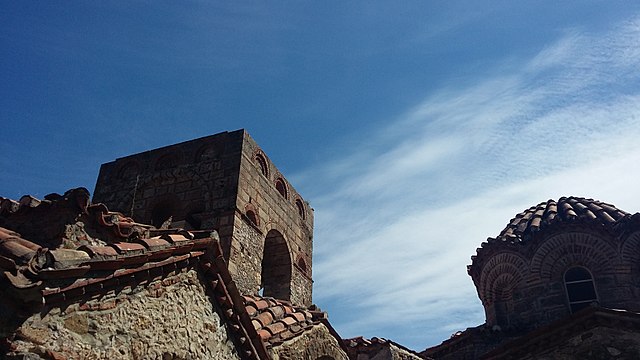
Impressions from Mystras, a Byzantine Castle Town. A visit to the archaeological site of Mystras these days will leave the visitor with new impressions and stimuli.
Among the collapsed buildings and the wildflowers of spring, the shining red fire protection cabinets of the new installation stand proudly.
They stand alone, 1.5 meters high without any support, often side by side with the informational signs of the archaeological service, which have now faded from the sun and are unreadable.
Unfortunately, the Public Power Corporation buried the electrical cables in the ground, missing the chance to set up the familiar wooden poles with hanging cables. Today, the Hellenic Electricity Distribution Network Operator is installing the new cables underground, as we learned, digging up the paths and blocking entire areas for the visitors.
The Upper Gate to the Castle is closed, and unless someone is a skilled climber and relatively young, they cannot climb up the small hill of Mystras under the sun.
The few guards are running up and down to prevent visitors from crossing the ropes and entering the restricted areas. Of course, there is no sign of a worker sweating, trying to finish the work as quickly as possible so the area can be open for visitors.
However, once this is finally done, we are sure there will be a way to see the beautiful frescoes and read the golden deeds, which can barely be distinguished in the mystical dim light of the churches. “If you turn on the flashlights of your mobile phones all together and stick them to the protective glass, you might be able to see them,” the guards directed us. Of course, only in the churches that were open, because many were not even accessible. “There aren’t enough guards for such a large space…”
One wonders, since there are not enough guards, who will use the fire protection system? Perhaps the reason the fire protection cabinets are so visible is so visitors can find them and quickly put out a fire.
Ah, modern Greek, you have done all things in wisdom!
(*) Kalliope Kontozoglou is an architect, Professor of Architecture at the University of Western Australia. She is also a Corresponding Member of the Komvos.
The article was first published in the online magazine kreport and is republished with the author’s permission.
The main photo is by Despoina Vavelidou (Wikipedia commons)
Disclaimer:
The “Opinions” section hosts the personal views and concerns of the columnists. Komvos encourages dialogue, without necessarily adopting every opinon expressed.