The Enduring Contribution of Greeks to Medicine and Biomedical Research
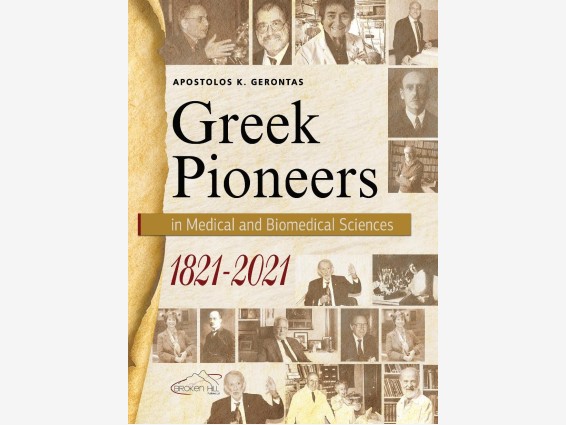
The book 1821–2021: Greek Pioneers in Medicine and the Biomedical Sciences highlights an important, though not always sufficiently known, dimension of modern Greek history: the contribution of scientists of Greek origin to the global development of medicine, biomedical research and pharmaceutical innovation.
The publication, authored by Apostolos Gerontas and published by Broken Hill Publishers, is based on a preceding study and focuses on Greek physicians and bioscientists whose work had a substantial impact on the progress of clinical medicine, biomedical research and the pharmaceutical industry during the 200 years from the Greek Revolution of 1821 to 2021.
The book was published in both Greek and English, with the aim of filling an identified gap in the modern scientific historiography of Greece and highlighting the enduring presence of Hellenism in the production of scientific knowledge of international significance.
A Study on the Scientific Excellence of Hellenism
The book presents personalities of Greek origin who distinguished themselves in different fields of medicine and biomedical sciences: from clinical practice and basic research to pharmaceutical innovation, biology, genetics, public health and the development of new therapeutic approaches.
The study was carried out under the auspices of the ARISTEiA Institute – Institute for the Advancement of Research & Education in Arts, Sciences & Technology, a non-profit organization founded in 2019 in the United States by Greeks abroad and in Greece, with the aim of promoting excellence in the global community, with particular reference to the communities of Greeks within and outside Greece. The American College of Greece placed the study under its academic umbrella.
The selection of the scientists included in the book was based on a systematic study of a significantly larger number of candidates, with criteria relating to the historical significance of their scientific work, its international impact, and its contribution to groundbreaking advances in medicine and the biosciences.
From the History of Medicine to Modern Biomedical Innovation
The publication is not merely a biographical record of distinguished scientists. It seeks to capture a broader historical continuity: the contribution of Greeks and scientists of Greek origin to the shaping of critical developments in medical knowledge and practice.
The contents of the book include, among others, figures such as Georgios Papanikolaou, Fotis Kafatos, Tom Maniatis, Spyros Artavanis-Tsakonas, Dimitrios Trichopoulos, Charalambos Moutsopoulos, George Chrousos, Paul Alivisatos, Nicholas Christakis, John Ioannidis, George Paxinos, Albert Bourla, Menelas Pangalos and Aristides Patrinos.
Through these trajectories, the book highlights how the Greek scientific presence became connected with different university, research and clinical environments in Greece, Europe and the United States. This contribution is not limited to individual achievements. It concerns the participation of Greek scientists in international knowledge ecosystems, the development of new scientific fields, and the formation of standards of scientific excellence.
The Mobility of Greek Scientists as a Source of Knowledge and Connection
One of the most interesting elements highlighted by the publication is the enduring mobility of Greek scientists between Greece and abroad. The international trajectory of many of the scientists presented in the book was not detached from Greece. On the contrary, in many cases it created ties, transfers of knowledge, returns, collaborations and remote interactions with Greek universities, research centres and hospitals.
This dimension is particularly important for the current discussion around brain drain and the relationship between Greece and its scientific diaspora. International mobility cannot be treated only as a loss of human capital. Under the appropriate institutional and networking conditions, it can function as a bridge of knowledge, collaboration and return of value to Greece.
The case of Greek pioneers in medicine and biomedical research shows that the diaspora is not merely a geographical reality. It is a field of relationships, possibilities and mutual reinforcement. The critical challenge is the transition from the recognition of individual distinctions to the systematic utilization of knowledge networks.
The Contribution of the Members of Komvos
For Komvos Networks of Global Hellenism this publication is of particular interest, as it is directly connected with the organization’s mission: to highlight and activate the human capital of Hellenism, in Greece and the diaspora, through networks of knowledge, scientific documentation and practical cooperation.
Of particular significance is the fact that, in the study, its scientific framing and the very content of the publication, distinguished scientists connected with Komvos come together.
Konstantinos Drosatos, Secretary General of the Board of Directors and Partner of Komvos, Professor of Pharmacology and Systems Physiology and holder of the “Ohio Eminent Scholar” Chair at the University of Cincinnati College of Medicine, had the idea and coordinated the study. He is also President of the ARISTEiA Institute, which served as the sponsor/commissioning body of the study.
Also participating in the scientific committee that contributed to the selection of the personalities presented in the book were two individuals with an active connection to Komvos: Nick Bouras, Emeritus Professor of Psychiatry at King’s College London and member of the International Advisory Committee of Komvos, and George Chrousos, Emeritus Professor at the National and Kapodistrian University of Athens, Director of the University Research Institute of Maternal and Child Health & Precision Medicine, Holder of the UNESCO Chair on Adolescent Health Care, and Partner of Komvos.
Among the personalities included in the publication is also Spyros Artavanis-Tsakonas, Emeritus Professor of Cell Biology at Harvard University, Former President of the National Council for Research, Technology and Innovation, and member of the International Advisory Committee of Komvos. His presence in the publication underlines the international reach of the Greek scientific diaspora and its contribution to central fields of modern biomedical research.
The connection of these individuals with the study and with the content of the book highlights the way in which the Komvos network intersects with initiatives of scientific mapping, historical documentation and international promotion of Greek excellence. This is not only a publication of historical interest, but a work that sheds light on the enduring contribution of Hellenism to global science and, at the same time, highlights the importance of international knowledge networks.
At the same time, the very content of the book meets the core of Komvos’ activity: connecting Greece with the diaspora, highlighting examples of excellence, and transforming knowledge into institutional, social and developmental capital.
Why It Matters Today
The recognition of Greek pioneers in medicine and the biomedical sciences does not concern only the past. It also concerns the way in which Greece can understand its position in the international knowledge ecosystem.
At a time when biomedical research, artificial intelligence in health, pharmaceutical innovation, genomics, precision medicine and public health are being rapidly transformed, the existence of a strong Greek scientific footprint abroad can serve as a basis for new collaborations.
The critical challenge is not simply to recognize the success of individual scientists. It is to transform this success into a network, institutional memory, scientific cooperation and a bridge to the next generation.
The publication Greek Pioneers in Medical and Biomedical Sciences 1821–2021 offers precisely this possibility: to view the Greek scientific diaspora not only as a history of distinctions, but as a living capital of knowledge, inspiration and cooperation.
For Komvos, the promotion of such works forms part of a broader effort: to illuminate the pathways through which Hellenism contributes meaningfully to global scientific progress and, at the same time, to explore ways in which this contribution can be more systematically connected with the needs, capacities and prospects of Greece.
Frequently Asked Questions
What is the book Greek Pioneers in Medical and Biomedical Sciences 1821–2021?
It is a publication that presents Greeks and scientists of Greek origin with a significant contribution to medicine, biomedical research and pharmaceutical innovation from 1821 to 2021.
Who is the author of the book?
The author of the book is Apostolos Gerontas, a researcher in the history of medicine and science.
What was the role of the ARISTEiA Institute?
The ARISTEiA Institute was the commissioning body of the study that preceded the publication, in collaboration with The American College of Greece.
Why is the book of interest to Komvos?
The book is connected with Komvos’ mission to highlight the human capital of Hellenism, illuminate the contribution of the diaspora and strengthen knowledge networks with an international orientation.
Which Komvos members are connected with the study and the publication?
Connected with the study and the publication are Konstantinos Drosatos and George Chrousos, Partners of Komvos, as well as Nick Bouras and Spyros Artavanis-Tsakonas, members of the International Advisory Committee of Komvos.