A major European distinction for the distinguished Greek planetary scientist and Partner of Komvos, whose long-standing career has placed her at the forefront of Solar System exploration and major international space missions.
Dr. Athena Coustenis, astrophysicist and Research Director at the French National Centre for Scientific Research (CNRS), at the Laboratory for Space Studies and Instrumentation in Astrophysics (LESIA) of the Paris Observatory, has been elected a member of Academia Europaea, one of Europe’s leading interdisciplinary academic institutions.
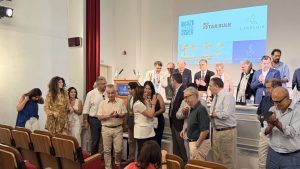
She was elected in 2026 to the Earth & Cosmic Sciences section, in recognition of her work in Astrophysics and Planetology. Dr Coustenis recently received her membership certificate and shared her delight at joining a community of scholars devoted to knowledge, research and international collaboration.
Athena Coustenis’ election holds particular significance for Komvos, of which she is a Partner. Her scientific career exemplifies the dynamic presence of global Hellenism in some of the world’s foremost centres of research and discovery.
European recognition of scientific excellence
Academia Europaea was founded in 1988 as a pan-European academy encompassing the sciences, humanities and letters. Today, it brings together more than 5,500 members from Europe and around the world, including more than 80 Nobel laureates.
Its members are elected on the basis of academic distinction, the quality of their work and its impact on research and society. The process involves nomination followed by peer review. Athena Coustenis’ election as an ordinary member therefore recognises a career of international reach and a substantial contribution to the advancement of planetary science.
A life devoted to distant worlds
Born in Athens and based in France, Athena Coustenis has dedicated her research to the atmospheres and surfaces of planets, their moons and exoplanets.
Among the celestial worlds she has studied, Titan holds a special place. Saturn’s largest moon, shrouded in a dense nitrogen atmosphere and marked by rivers and lakes of liquid hydrocarbons, offers a natural laboratory for studying organic chemistry and the evolution of planetary environments.
The study of Titan brings science face to face with some of humanity’s most enduring questions: how planetary worlds form and evolve, which conditions shape their environments, and where in the Universe the prerequisites for life may exist.
From Cassini–Huygens to the missions of the future
Athena Coustenis played an active role in the historic Cassini–Huygens mission of NASA, ESA and the Italian Space Agency, which transformed our understanding of Saturn and its moons. She served on the scientific teams of instruments aboard both the Cassini spacecraft and the European Huygens probe, which landed on Titan in January 2005.
The mission’s data revealed a world of mountains, dunes, clouds and rainfall, with a methane cycle that, through a very different chemistry, echoes the water cycle on Earth.
Her scientific work also extends to JUICE, bound for Jupiter’s icy moons; MMX, which will explore the moons of Mars; and Ariel, designed to study the atmospheres of exoplanets. Through these missions, planetology is moving from observation towards the comparative study of entire planetary systems.
International presence and scientific responsibility
Athena Coustenis’ research output includes approximately 260 scientific articles, books and book chapters, along with more than 700 presentations and papers delivered at international scientific conferences.
She chairs the COSPAR Panel on Planetary Protection, which contributes to the development of international standards for the responsible exploration of the Solar System. Planetary protection encompasses the preservation of celestial bodies of particular scientific and astrobiological interest, as well as the safe return to Earth of samples collected from other worlds.
From 2024 to 2025, she also served as Chair of the Division for Planetary Sciences of the American Astronomical Society. Her contribution has been recognised through major international distinctions, including the Harold Masursky Award, the Jean Dominique Cassini Medal of the European Geosciences Union and the rank of Knight of the Legion of Honour in France.
Another bridge for global Hellenism
Athena Coustenis’ election to Academia Europaea highlights a scientific journey that began in Athens, developed in Paris and has reached as far as Titan, Jupiter, Mars and planets orbiting other stars.
At the same time, it reflects the contribution of Greek scientists in the diaspora at the forefront of international research: people who carry knowledge across countries and institutions, forge new collaborations and sustain a creative relationship with Greece.
Komvos warmly congratulates its Partner, Dr. Athena Coustenis, on her election and wishes her every success in this new and inspiring chapter at Academia Europaea.