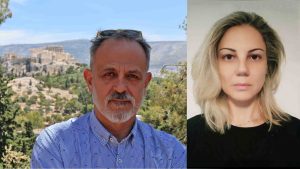
A Greek Scientist at the Cutting Edge of Planetary Science
Dr. Anezina Solomonidou, a member of Komvos’ International Advisory Committee, belongs to the elite group of Greek scientists shaping the future of solar system exploration. With a distinguished career at both NASA and the European Space Agency (ESA), she has participated in landmark space missions and currently represents Greece in the ESA’s Human and Robotic Exploration programme.
In a recent interview with journalist Anna Grimani—founding member of Komvos—for the Women in Business & Science platform, Dr. Solomonidou reflects on her career, scientific quests, and a lifelong need to understand the universe: “I could never settle for the surface of things. I was always chased by curiosity; I always needed to know why.”
Her journey begins in Milos, where, as she recalls, “the volcanic landscapes, cliffs, minerals, and sea sparked endless questions in my childhood imagination.” Today, as a planetary scientist, she investigates the geology and subsurface oceanic environments of Titan, Europa, and Ganymede—seeking to understand the habitability of worlds beyond Earth. She has contributed to major missions such as: Cassini-Huygens – the study of Titan and its atmospheric dynamics (NASA/ESA), JUICE – Jupiter Icy Moons Explorer – now en route to Jupiter to explore its frozen moons (ESA) and Europa Clipper – a mission to study Europa’s subsurface ocean (NASA).
Since 2019, she has also been a vital link between the Greek scientific community and European space policy through the Hellenic Space Center. “We must understand that space is not a luxury—it’s a strategic choice. It’s knowledge, cooperation, technology, and above all, preparation for the future.”
Dr. Solomonidou also plays an active role in Komvos’ initiative “Space Science and Industry,” which aims to map Greek capabilities in space science and technology and strengthen links between stakeholders in the field. The initiative, coordinated by Komvos members Stamatios Krimigis and Athena Coustenis, seeks to highlight areas where Greece can make substantial contributions to the global space community.
Dr. Solomonidou also emphasizes the direct connection between planetary science and Earth: “By studying Titan, Europa, or Mars, we learn to recognize the signs of climate collapse, geological transformation, and life. Looking to space brings us back to our own planet.”
Her example is powerful: a woman scientist in a high-expertise, male-dominated field, committed to international collaboration and long-term vision. “Science is a long-distance race. It requires courage and devotion. It’s not about applause—it’s about offering something real to humanity’s collective quest.”
Dr. Solomonidou highlights the importance of international cooperation, scientific curiosity, and inspiring younger generations—not only for space exploration but also for addressing today’s global challenges such as the climate crisis. She is a valued member of the Komvos international community and a voice that bridges the frontiers of space research with the critical concerns of our time.
Read the full interview (in Greek): Συνέντευξη: ΑΝΕΖΙΝΑ ΣΟΛΩΜΟΝΙΔΟΥ, Πλανητολόγος – Women In Business & Science