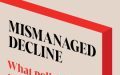
What Politicians Won’t Tell You About the Economy
The book Mismanaged Decline: What Politicians Won’t Tell You About the Economy by economists Vicky Pryce and Andy Ross provides a timely opportunity to reflect on the economic policy choices that shaped today’s UK economy, as well as the challenges faced by modern developed economies more broadly. Drawing on the UK’s long historical journey from the Industrial Revolution to the present, the authors offer a measured assessment of the structural decisions and policy measures that led to the gradual weakening of the productive base and the development of an economy heavily dependent on services.
Vicky Pryce, founding member of Komvos, is an internationally recognized economist, Chief Economic Adviser, and Board Member of the Centre for Economics and Business Research (CEBR). She previously served as Joint Head of the UK Government Economic Service. Together with Andy Ross, she brings extensive frontline experience in shaping and evaluating economic policy. The result is a book that combines rigorous evidence with political realism, free from ideological bias.
From Industrial Strength to Contemporary Challenges
At the core of the analysis lies the question of how a country with a strong industrial tradition gradually moved toward an economic model with increased vulnerabilities, low investment capacity, and limited growth potential. The authors examine in depth the process of deindustrialization, responses to globalization, and the impact of major recent events such as Brexit, the Covid-19 pandemic, and the war in Ukraine.
They also analyze the long-term consequences of climate change, rising inequality, and migration, not as isolated phenomena, but as interconnected factors affecting the overall resilience of the economy and society.
Political Honesty and Realism
One of the central messages of Mismanaged Decline is the need for political honesty. The authors argue that there are no “magic solutions” or sudden economic resets. Instead, addressing today’s challenges requires realistic choices, long-term planning, and moving away from populist narratives promising easy fixes.
The book advocates a pragmatic approach to economic policy, based on evidence rather than ideology. As the authors emphasize, “good economic policy does not follow ideological dogmas,” but is shaped according to the real needs of society and production.
A Book of Broader European Relevance
Although the focus is on the UK experience, the book’s conclusions have clear European and international relevance. Issues such as productive reconstruction, sustainable growth, social cohesion, and resilience against geopolitical shocks are highly pertinent to public discourse in Greece as well.
In a period of increasing uncertainty, Mismanaged Decline offers a valuable framework for thinking about how modern economies can move toward a fairer, stronger, and more resilient development model.
The book represents an important contribution to discussions on the future of economic policy and aligns with Komvos’ broader mission of fostering evidence-based dialogue between science, policy, and society.
You can find more information about the book, here.