Hubris: an enduring concept
Hubris is one of the most distinctive concepts of ancient Greek thought, offering a powerful interpretive framework that remains highly relevant today. It goes beyond mere arrogance, referring to a deeper transgression of limits—often associated with power, success, and decision-making.
In contemporary contexts, hubris has re-emerged as a key lens through which leadership behavior is examined, particularly in environments where influence and authority are concentrated—from politics to business.
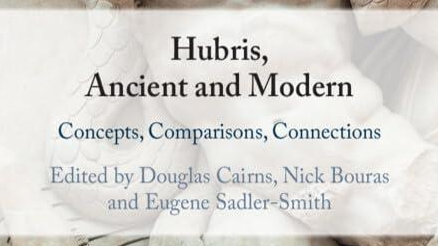
The collective volume Hubris: Ancient and Modern – Concepts, Comparisons, Connections explores this continuity, bringing ancient Greek perspectives into dialogue with modern scientific approaches.

The contribution of Nikandros Bouras
The volume includes the contribution of Nick Bouras, Emeritus Professor of Psychiatry at King’s College London and co-editor of the book. His academic work focuses on the intersection of mental health, human behavior, and the mechanisms that shape decision-making.
His contribution is situated within the fields of psychiatry and the neuropsychology of leadership, where hubris is examined as a phenomenon that can influence judgment, behavior, and the exercise of power.
He is also a member of the International Advisory Committee and the Initiative Team for the establishment of Komvos, further strengthening the organization’s connection to the global academic community and to interdisciplinary approaches addressing complex societal challenges.
From ancient thought to modern science
The book approaches hubris through a multidisciplinary lens, combining Classics with psychology, neuroscience, and management studies.
Within this framework, hubris is not only treated as a philosophical or ethical notion, but also as a factor shaping behavior and decision-making. Contemporary research associates it with excessive self-confidence, impaired risk assessment, and detachment from critical feedback.
In particular, the concept has gained prominence in leadership and management studies, where it is used to explain high-level decision failures and organizational breakdowns.
Hubris and power
Modern scholarship suggests that hubris is not merely an individual trait, but often emerges within specific contexts.
The accumulation of power, repeated success, and reduced accountability can all act as catalysts. In such environments, the transition from confidence to overconfidence may occur gradually and without clear warning.
Hubris, therefore, is not only about individuals—it is also about the systems within which they operate.
Why it matters today
In an increasingly complex world, where decisions carry far-reaching consequences, understanding hubris becomes particularly important.
It can contribute to:
- interpreting leadership behavior
- identifying risks in decision-making
- promoting more balanced and responsible approaches
The persistence of this concept across time suggests that certain behavioral patterns remain remarkably stable, even in rapidly evolving environments.
A bridge between past and future
Revisiting hubris through modern scientific perspectives is not merely an academic exercise. It offers a valuable framework for understanding contemporary challenges and avoiding recurring failures.
The integration of different fields of knowledge, as demonstrated in this volume, reflects the broader philosophy of Komvos: fostering connections between disciplines, ideas, and people in order to address complex global issues.
More information about the book is available here:
https://www.cambridge.org/core/books/hubris-ancient-and-modern/76140EB504DB962DD9C4A3CB2F01EEE7