
You are currently viewing AI for Families

AI for Families

How Do We Prepare Children for Life with Artificial Intelligence?

Artificial Intelligence has already become part of children’s everyday lives. They use it for schoolwork, to search for information, create images and texts, experiment with new ideas, or even seek personal advice. At the same time, parents are being called upon to understand a technology that is evolving faster than the rules, habits, and knowledge we have developed around it.

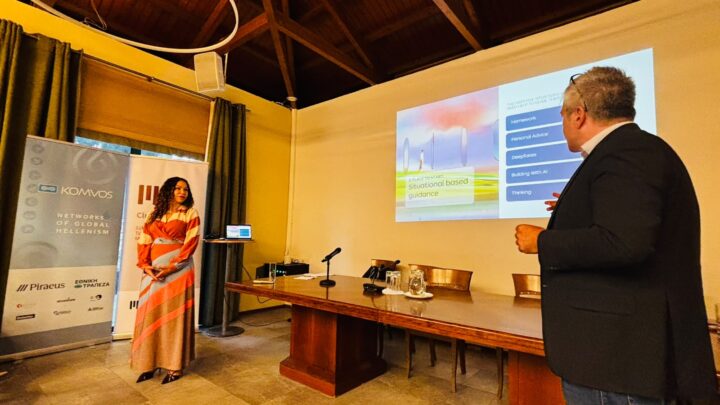
This new landscape was the focus of the “AI for Families” session, featuring Nikos Mavridis, Corresponding Member of Komvos, and Melissa Saoudy, held as part of the event “From Dubai to Athens: AI, Families and Entrepreneurial Government” on 9 September 2026 at the SAKA premises on the Athens College campus.

The discussion did not focus solely on the risks associated with children’s use of AI. It also highlighted the creative possibilities it offers and the need to equip parents with practical tools so they can guide their children with knowledge, composure, and active involvement.

Nikos Mavridis: Technology Should Help People Think and Create

The session opened with Dr Nikos Mavridis, Professor of Artificial Intelligence, MIT alumnus, and head of Komvos’ AI’nclusion – Artificial Intelligence Without Exclusion initiative.

Drawing on his own journey in AI and robotics, he spoke about his childhood dream of creating a robot that could serve as both an assistant and a friend. Years later, that dream took shape in the first interactive robot he developed during his doctoral research at MIT.

Today, as he observed, children are growing up in an environment where a “digital relative” of those early robots is available on every computer and mobile phone. A child can use AI with a parent to write a bedtime story, develop an idea, solve a problem, or imagine different versions of the future.
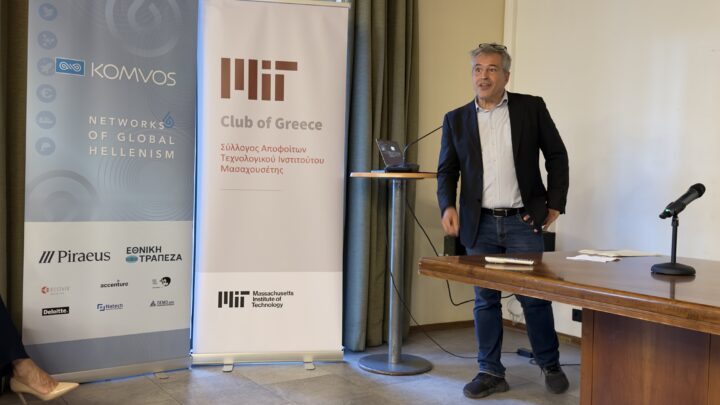
This vision was linked to a broader question: what kind of society do we want to create with the help of AI?

Nikos Mavridis described a future in which technology frees people from repetitive and impersonal tasks, fosters creativity, broadens access to knowledge, and enables citizens to participate more actively in decisions that affect their lives. A central principle of this approach is that people should not be trained to function like machines. Machines should help people think, create, and care for one another and for the planet.
As he pointed out, this transition needs to be built on three pillars:

  • preparing people and society for the age of AI;
  • developing a participatory economy that empowers workers instead of rendering them redundant;
  • fostering a culture of trust, ethics, and democratic oversight.

Technological progress will not wait. The challenge, therefore, is not to slow it down, but to accelerate the social preparation needed to keep pace with it.

Melissa Saoudy: Preparation Begins at Home

AI education concerns students, employees, educators, businesses, and public administration. For children, however, preparation begins within the family.

This observation provided the link to the presentation by Melissa Saoudy, a social innovation and public transformation consultant with many years of experience in the United Arab Emirates and founder of The Why. From the outset, Melissa Saoudy set out a clear position: the family must be recognised as a fundamental unit of Artificial Intelligence governance.

Generative AI applications spread so rapidly that families had no time to develop commonly accepted rules. ChatGPT took just two months to reach 100 million users. Within this short period, parents were called upon to decide what should be permitted, what risks exist, when intervention is necessary, and how to discuss with their children a technology that they often understand less well than the children themselves.

Children Are Already Using AI – Families Are Seeking Guidance

According to the data presented, young people are integrating AI into their daily lives faster than adults. In the United Kingdom, AI use in 2025 was estimated at 47% among adults and 67% among teenagers aged 13–18. For Greece, the figures presented were 44% among adults and 83% among teenagers.
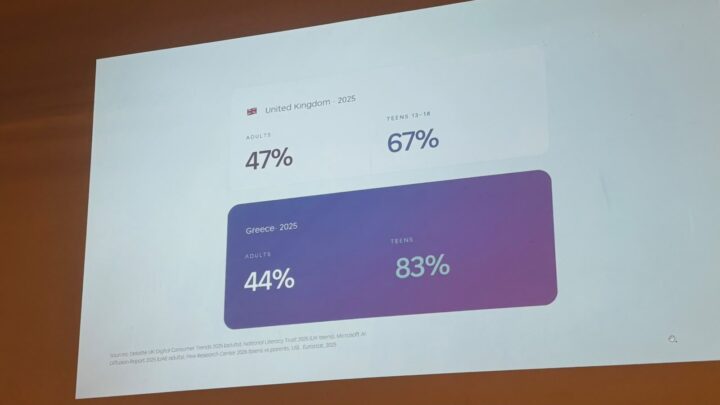
The individual percentages depend on the methodology used in each study, but the trend is clear: parents are being asked to guide children who already use tools that they themselves may not yet fully understand. They are concerned about schoolwork, deepfakes, exposure to inappropriate content, personal data protection, and the impact of AI on critical thinking, without always feeling that they have the knowledge and appropriate tools to intervene.

In recent years, significant initiatives have been developed to protect children and educate them about AI. International organisations such as UNICEF and UNESCO have published guidelines, while MIT RAISE has developed pioneering educational resources for AI literacy.

Most of these policies and tools are aimed primarily at schools, digital platforms, and institutions. The family is often left out of the core planning, even though the home is where children use digital applications with the least supervision.

“AI is already part of childhood” was one of the presentation’s central observations. The key question is how children will use it and who will help them develop the necessary skills and habits.

Four Different Parental Approaches

As part of the initiative’s preparation, discussions were held with more than 50 parents. The research identified four main approaches to children’s use of AI:

  • The “Guardian” sets rules, monitors use, and seeks to remain aware of what is happening, but needs tools to ensure that supervision does not become stifling control.
  • The “Coach” views AI as a skill, is usually more familiar with technology, and actively guides the child.
  • The “Watchful” is interested but feels unprepared and generally intervenes only when a problem arises.
  • The “Trusting” has a positive attitude towards technology and gives the child greater freedom, but may not recognise certain risks early enough.

There are also parents who have not yet engaged in the discussion—not necessarily because they reject AI, but because they have not realised the extent to which it is already part of their children’s lives.

Children Equipped with Judgement, Creativity, and Safety

The vision presented by Melissa Saoudy can be summarised in three concepts: wisdom, creativity, and safety.

Children need to develop sound judgement so they can recognise what is real, evaluate a system’s responses, and think independently. At the same time, they can use AI to write, design, experiment, and turn an initial idea into something more sophisticated, with technology enhancing their imagination without replacing their own thinking.

Safety is the foundation of this relationship. Children must be protected from harmful content, deceptive applications, personal data breaches, fraud, and dependency, while also being prepared for a world in which AI will be ever-present.

Five Situations Families Are Already Facing

The proposed approach focuses on children aged 7–15 and is organised around real situations arising in family life:

  • A child submits a flawless school assignment, and the parent suspects it was generated entirely by AI.
  • A child asks a chatbot for personal or emotional advice.
  • A fake image or deepfake involving the child or one of their classmates appears.
  • A child wants to use AI to create a text, an image, a story, or a project of their own.
  • Continuous use of AI begins to affect how the child thinks, conducts research, and evaluates information.

Each of these situations calls for simple, practical guidance tailored to the child’s age, which parents can use when faced with a real incident.

From Prohibition to Co-Use

Of particular interest was the concept of co-use: parents and children using AI together. Through a small creative project or a shared search, parents can observe how their child thinks, explain their own choices, and pass on good digital habits without the process feeling like surveillance.

Co-use was compared to learning to drive: parents do not simply provide a list of rules but remain beside the child, demonstrating in practice how to use a powerful tool responsibly and intervening when necessary.

ται.

A Dialogue Without Ready-Made Answers

The presentation developed into an open discussion with the audience. Participants exchanged views on how parents can be encouraged to engage, how AI can be integrated into the learning process, and who should have access to data generated through minors’ use of AI applications.

Among the issues raised was the possibility of parents receiving a periodic summary of the topics their children discuss with an AI system, as well as the use of anonymised, aggregated data to understand emerging patterns of use. These proposals could contribute to the early identification of risks, but they also raise important questions concerning privacy and children’s developing autonomy.

As both speakers emphasised, this is a new field in which all the necessary knowledge has yet to be gathered. Many questions do not have an obvious right or wrong answer. Applications are constantly evolving, user habits are changing, and every intervention may have consequences that are not immediately apparent.

For this reason, knowledge will be built through research, open dialogue, the testing of different approaches, and the participation of parents, children, educators, experts, institutions, and technology companies.

Komvos’ AI’nclusion Initiative

The event formed part of Komvos’ AI’nclusion – Artificial Intelligence Without Exclusion initiative, which promotes access to knowledge, AI literacy, and its responsible use by different groups across society. Following initiatives for teachers, students, and the wider education community, AI for Families extends the discussion to families and the practical needs of parents.

The initiative reflects AI’nclusion’s core direction: collaboration among the scientific community, educators, families, government, businesses, and civil society, so that Artificial Intelligence can be used knowledgeably, responsibly, and inclusively.

What Is the Role of Parents in the Age of AI?

The role of parents is not to understand every application or monitor their child’s every move. It is to keep communication open, learn alongside their child, set clear boundaries where necessary, and help them develop critical thinking, creativity, and responsible digital habits.

AI will continue to evolve. The active presence of parents, trust, and human connection will remain the constant points of reference.



The event was part of the AI’nclusion – Artificial Intelligence Without Exclusion initiative and was co-organised by the MIT Club of Greece, the MIT Club of the UAE, Komvos – Networks of Global Hellenism, AICatalyst, and the Hellenic Artificial Intelligence Society, with the support of Codrus Capital AG.