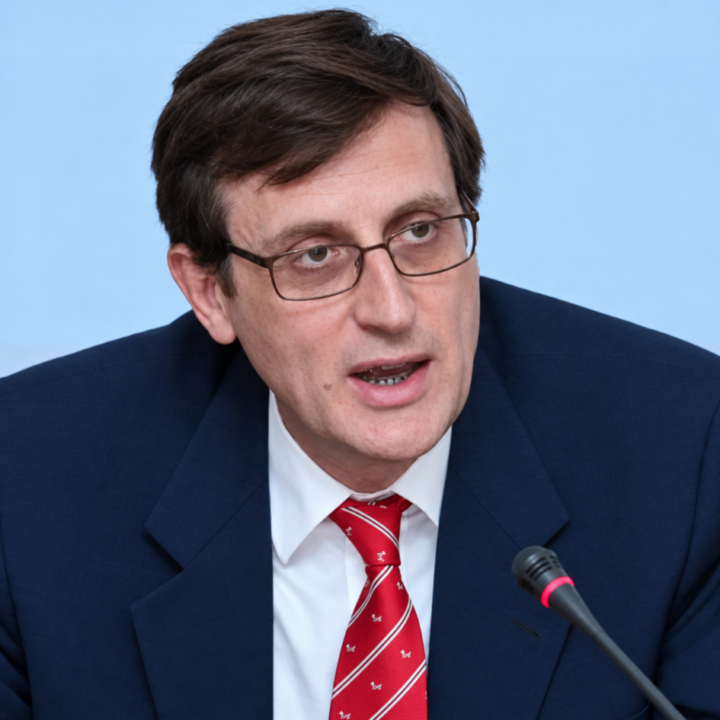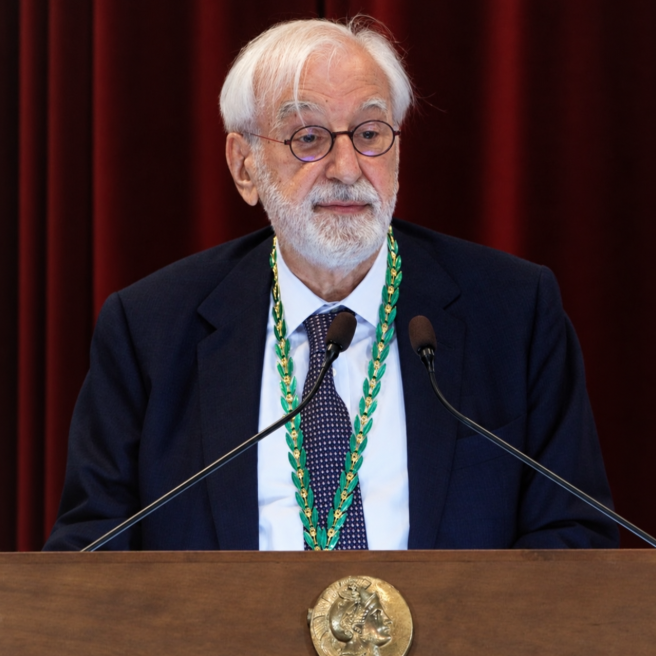
Professor Haralampos M. Moutsopoulos MD, PhD, a Full Member of the Academy of Athens, was born and raised in Ioannina, Greece. He is one of the most distinguished figures in modern Greek medicine and has made seminal contributions to the advancement of Rheumatology and Immunology, with particular emphasis on the study of autoimmune rheumatic diseases.
He received his Doctor of Medicine (MD) degree and his Doctor of Philosophy (PhD) degree from the National and Kapodistrian University of Athens. He subsequently completed postgraduate training in Internal Medicine at Georgetown University in Washington, D.C., and specialized in the study of autoimmune rheumatic diseases at the University of California, San Francisco.
He subsequently served as a researcher at the United States National Institutes of Health (NIH) and as a Clinical Associate Professor of Medicine at Georgetown University School of Medicine. He was elected Professor and appointed Director of the First Department of Internal Medicine at the University of Ioannina. Fourteen years later, he was elected Professor and Director of the Laboratory of Pathophysiology at the Medical School of the National and Kapodistrian University of Athens. Through his work at these institutions, he made substantial contributions to the development of university education and biomedical research in Greece.
Research and Scientific Contributions
Professor Moutsopoulos research focuses on investigating the pathogenic mechanisms and clinical manifestations of autoimmune rheumatic diseases. Sjögren’s syndrome occupies a central place in his research and has served as a model disease for the systematic study of autoimmunity and the mechanisms underlying the development and progression of autoimmune disorders.
Through decades of research, he has made substantial contributions to advancing our understanding of the pathogenesis of Sjögren’s syndrome. Based on his research findings, he proposed the term “autoimmune epithelitis” to more accurately reflect the central role of the epithelium in the pathophysiology of the syndrome. His research in this field was summarized in a review published in Current Opinion in Immunology in October 2026 (102:102815; DOI: 10.1016/j.coi.2026.102815).
His scientific work includes more than 600 publications in international peer-reviewed scientific journals. His publications have accumulated more than 60,500 citations, and, according to Google Scholar, his h-index stands at 128 in 2026. A complete list of his publications is available through the international bibliographic database PubMed.
International Academic Presence
Professor Moutsopoulos has been invited to deliver numerous lectures at international Rheumatology and Immunology conferences, as well as at universities, research centers, and medical institutions around the world. His scientific activities have extended across Europe, the United States, Mexico, Argentina, Brazil, Chile, Australia, Israel, Jordan, Japan, the former Soviet Union, and China.
He has also held visiting professorships at the Faculty of Medicine in Brest, France; the University of California, Davis; the University of Texas Health Science Center at San Antonio; and Hospital for Special Surgery in New York, which is affiliated with Weill Cornell Medical College.
Authorship and Editorial Contributions
Professor Moutsopoulos has contributed chapters to leading international medical textbooks, including Harrison’s Principles of Internal Medicine (McGraw Hill), Oxford Textbook of Rheumatology, Kelley’s Textbook of Rheumatology (Elsevier), Rheumatology (edited by Hochberg M. et al.; Elsevier), and Autoimmune Diseases (Academic Press).
He has authored or edited two books on Sjögren’s syndrome, Rheumatology in Questions, Immunology–Rheumatology in Questions, and Passion for Excellence (Springer Nature).
Scientific Honors and Distinctions
In recognition of his scientific contributions, Professor Moutsopoulos has received numerous honorary distinctions from Greek and international scientific organizations.
His professional honors and fellowships include:
- Honorary Member of the British Society for Rheumatology.
- Fellow of the American College of Physicians (FACP).
- Honorary Fellow of the Royal College of Physicians of Edinburgh (FRCP Edin).
- Honorary Fellow of the Royal College of Physicians of London (FRCP Lon).
- Master of the American College of Rheumatology (MACR).
Among the most significant national and international distinctions conferred upon him are the following:
- “Alessandro Robecchi” Award for Research in Rheumatology, awarded by the European League Against Rheumatism (EULAR), 1987.
- European–Australian Award for Medical Research, 1993.
- Distinction awarded by the Hellenic Society for Immunology, 2001.
- “Xanthopoulos–Pneumatikos” Award for Excellence in University Teaching, 2005.
- “Distinguished Scholar Clinician Award”, awarded by the American College of Rheumatology (ACR), 2006.
- “Charles Von Pirquet Award”, awarded by the University of California, Davis, in 2007 in recognition of his distinguished contributions to medicine and immunology.
- Title of Hippocratic Orator, conferred by the Hellenic Medical Society of London, 2008.
- Bodossaki Prize, 2010, awarded following evaluation by an international panel of experts.
- Meritorious Service Award, awarded by the European rheumatology community in 2010 in recognition of his outstanding contributions to Rheumatology.
- Professor/Director pro tempore, Hospital for Special Surgery, affiliated with Weill Cornell Medical College, New York, USA, 2011.
- Commander of the Order of the Phoenix, conferred by the President of the Hellenic Republic in 2014.
- His name is included in “1821–2021: Greek Pioneers in Medicine and Biomedical Sciences”, a historical work by Apostolos K. Gerontas, produced under the auspices of the ARISTEIA Institute and the American College of Greece.
- Honorary Professor at the University of Ioannina, Democritus University of Thrace, and the National and Kapodistrian University of Athens.