International recognition for Vasilis Ntziachristos and his work in non-invasive imaging
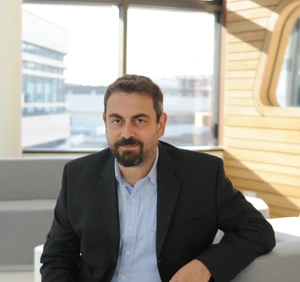
Vasilis Ntziachristos, Professor of Biological Imaging at the Technical University of Munich, Director of the Institute of Biological and Medical Imaging and the Bioengineering Center at Helmholtz Munich, and a Partner of Komvos, has been awarded the Future Insight Prize 2026 by Merck. The award comes with €300,000 in research funding and recognises his work on the non-invasive monitoring of human biology.
Optoacoustic imaging uses pulses of light and the ultrasound waves generated within tissue to produce detailed images of biological structures and functions.
The Future Insight Prize is awarded to research approaches with broad potential for future applications. In the case of Vasilis Ntziachristos, the funding will support the further development of technologies that enable continuous, non-invasive measurement of biological parameters.
How does optoacoustic imaging work?
The technology is based on the combination of light and sound. Short pulses of light are absorbed by molecules and structures within tissue, causing very small changes in temperature. These generate ultrasound waves, which are detected by sensors and converted by software into high-resolution images.
Ntziachristos’ research team has developed different versions of the method. These include Raster Scan Optoacoustic Mesoscopy (RSOM), which enables the imaging of small blood vessels and other structures within and beneath the skin.
RSOM has already been used in research on dermatological conditions, diabetes and cardiometabolic disorders. Optoacoustic methods can also provide information on tissue oxygenation, blood flow and lipid content.
At the Technical University of Munich, researchers are also exploring the use of multispectral optoacoustic tomography to monitor dynamic biomarkers, including tissue perfusion and oxygenation.
The same technological platform has also been combined with artificial intelligence. In related research, images of blood vessels in the skin were used to identify features associated with diabetes and its progression.
From research to healthcare applications
Vasilis Ntziachristos currently directs the Institute of Biological and Medical Imaging (IBMI) and the Bioengineering Center at Helmholtz Munich, while holding the Chair of Biological Imaging at the Technical University of Munich.
His scientific work spans imaging, sensors, computational methods and the clinical application of emerging technologies.
He studied Electrical Engineering at Aristotle University of Thessaloniki and went on to complete graduate and doctoral studies in Biomedical Engineering at the University of Pennsylvania.
From 2002 to 2007, he worked at Harvard University and Massachusetts General Hospital as Assistant Professor and Director of the Laboratory for Bio-Optics and Molecular Imaging. He has been based in Munich since 2007.
His academic work has also led to commercial applications of research. Among the companies he has helped establish is Spear, a spin-off of Helmholtz Munich and the Technical University of Munich that develops advanced imaging technologies for healthcare.
Merck awarded the Future Insight Prize to Ntziachristos as a representative of Spear.
Bioengineering lies at this intersection between science and application. It combines engineering, biology and medicine and is used to develop new tools for prevention, diagnosis and treatment.
Why is bioengineering gaining attention in Europe?
A few weeks after receiving the award, Vasilis Ntziachristos co-authored an article in Nature with Thomas Schwarz-Romond and Fiona M. Watt entitled “Europe can become a bioengineering powerhouse with these three changes”.
Published on 4 August 2026, the article focuses on the need for greater investment and education in bioengineering so that Europe can make better use of its existing strengths in the life sciences.
The issue returned to the agenda in late September through Helmholtz Munich, as part of a broader discussion on technologies that could support new areas of growth in the European economy.
At the centre of this discussion is the transition from basic research to products, services and new companies. At the same time, demand is increasing for scientists and engineers who can work across medicine, biology, data and technology.
Optoacoustics provides a clear example of this progression: from a research method to imaging systems, sensors, clinical studies and commercial applications.
Vasilis Ntziachristos and Komvos
Vasilis Ntziachristos is Professor of Biological Imaging at TUM, Director of the Institute of Biological and Medical Imaging at Helmholtz Munich, a founding member and a Partner of Komvos.
His relationship with Komvos is closely linked to its activity in biotechnology and the life sciences. He has taken part alongside other Komvos members in initiatives that bring together the scientific community, entrepreneurship and the biotechnology ecosystem.
His work also connects with the current discussion on the role of biotechnology, bioengineering and emerging technologies in the Greek economy and in international collaboration.
At the 4th Annual Working Conference of Komvos, on 23 November 2026, biotechnology will be one of the areas addressed under the central theme “Greece as a Hub for the Future – Innovation, Synergy and Growth”.
Vasilis Ntziachristos’ international career fits directly within this agenda: research with global reach, technological development, clinical applications and companies that bring research to market.