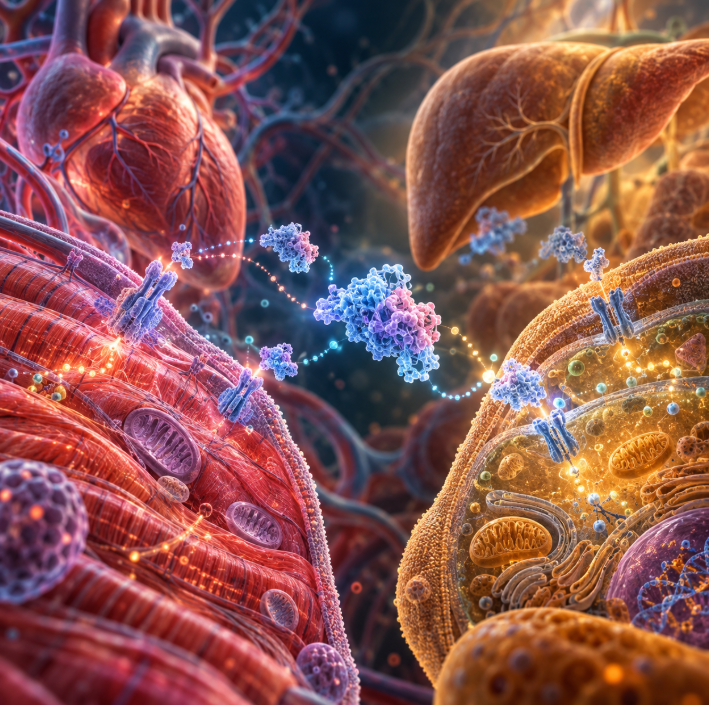
Research on the liver–heart axis
Konstantinos Drosatos, Professor of Pharmacology and Systems Physiology and holder of the “Ohio Eminent Scholar” Chair at the University of Cincinnati College of Medicine, Secretary General of the Board and Partner of Komvos, has played a central role in a study examining the liver–heart communication axis and the role of the FGF21 protein.
Cardiac hypertrophy is an increase in the size and thickness of the heart muscle in response to increased workload, as may occur in conditions such as hypertension or aortic valve stenosis.
The study, entitled “Hepato-cardiac interorgan communication controls cardiac hypertrophy via combined endocrine-autocrine FGF21 signaling”, was published in Cell Reports Medicine and examines how this protein is involved in communication between the two organs.
What did the research show about FGF21?
The research team studied FGF21, a hormone produced primarily by the liver that plays a role in metabolic regulation. The results show that under conditions of increased cardiac workload, a communication mechanism between the liver and the heart is activated, with this hormone playing a central role.
In human data, the researchers recorded elevated levels of the hormone in the blood of patients with left ventricular hypertrophy or hypertension. Increased FGF21 expression was also identified in cardiac tissue samples from people with hypertension.
The causal sequence was investigated in experimental models. The increase in FGF21 in the liver appeared first, followed by a corresponding increase in cardiomyocytes. This second phase coincided with the development of hypertrophy and changes in cardiac function.
The team also showed that inhibiting this mechanism, either in the liver or specifically in cardiac cells, reduced hypertrophy and improved indicators of cardiac function.
Why does communication between organs matter?
The research is part of a broader field in modern biomedicine examining how different organs communicate through hormones, metabolic signals and other molecules.
FGF21 has been extensively studied for its metabolic properties, particularly in relation to obesity and metabolic syndrome. The findings add evidence about its role in the heart and about how the duration and biological context of its activation may affect cardiac muscle.
The authors describe this complex picture as the “FGF21 paradox”. To present the findings to a wider audience, they also produced an explanatory video included in a recent University of Cincinnati feature.
Who is Konstantinos Drosatos?
Konstantinos Drosatos is Professor of Pharmacology and Systems Physiology and holder of the “Ohio Eminent Scholar” Chair at the University of Cincinnati College of Medicine in the United States. His research focuses on the mechanisms linking cardiac stress with metabolism and with conditions including diabetes, sepsis and heart failure.
He studied Biology at Aristotle University of Thessaloniki and continued with postgraduate and doctoral studies in Molecular Biology and Biomedicine at the University of Crete and Boston University. He subsequently conducted postdoctoral research at Columbia University and pursued an academic career at Temple University before moving to Cincinnati.
He is also a Fellow of the Basic Cardiovascular Sciences Council of the American Heart Association and has held scientific and organisational roles in international biomedical research networks.
At Komvos, Konstantinos Drosatos is Secretary General of the Board, Partner and Coordinator of the Biotechnology Initiative. Together with Nikos Kyrpides, also a Partner of Komvos, he coordinated the first meetings on Health–Biotechnology–Economy Synergy Structures.
How is the research connected to the 4th Conference?
At the 4th Annual Working Conference of Komvos, on 23 November 2026, the Biotechnology Initiative will present the next stage of HeaL-SPRIT – Health and Life Sciences Park of Research, Industry and Training, an initiative of Komvos and the ARISTEiA Institute aimed at creating an organised ecosystem linking research, biomedicine, the pharmaceutical industry, education and business development in Greece.
Konstantinos Drosatos’ research activity provides a concrete example of the scientific potential of the international Greek network. It also illustrates how basic and translational research can lead to the investigation of new biological mechanisms and, at a later stage, potential therapeutic approaches.
The findings open a new field of investigation into the role of FGF21 in cardiac hypertrophy and the possible future therapeutic applications of this mechanism.
The connection between scientific knowledge, research infrastructure, industry and international networks lies at the core of Komvos’ Biotechnology Initiative and the broader work that will be presented at the 4th Komvos Working Conference.