From Use to Understanding and Responsible Application
Artificial intelligence in education is not merely a new tool, but a defining factor shaping access to knowledge, the learning process, and social inequalities. The core challenge lies not in its use, but in its understanding and responsible application.
Who – What – When – Where
On Thursday, March 26, at Panteion University, a seminar was held on:
“Artificial Intelligence in Education: Recent Research and Pedagogical Approaches – From Use to Understanding and Responsible Application”
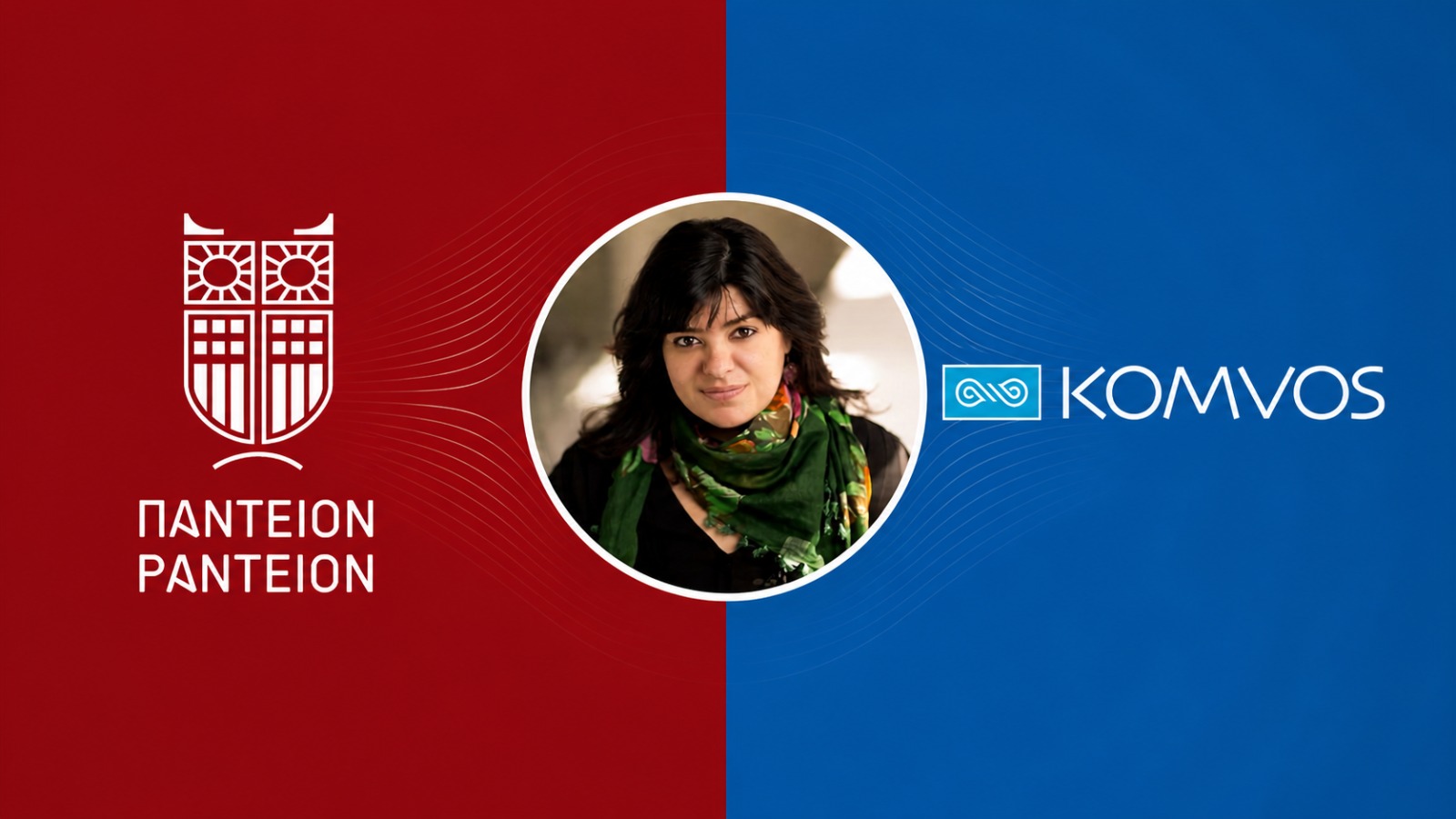
The seminar was initiated by Komvos Associate Members Dr. Kostas Karpouzis and Dr. Nikolaos Mavridis, and co-organized by Komvos – Networks of Global Hellenism and Panteion University, within the framework of Komvos’ AI’nclusion initiative.
During the seminar, Dr. Katerina Bagiati (Principal Research Scientist, MIT Media Lab, MIT RAISE) highlighted the shift from use to understanding and the responsible application of AI.
The initiative was part of Girls in Digital Week 2026, organized within the framework of EU Code Week, reinforcing the importance of equal participation and empowerment through technology

From Use to Understanding
Artificial intelligence is now part of the broader STEM (Science, Technology, Engineering, Mathematics) framework, which extends beyond technical skills to a different way of understanding the world.
The key shift highlighted is clear:
it is not enough to use AI — we must understand it in order to minimize risks and maximize its benefits.
This means:
-understanding how it works
-being aware of its limitations and the risks of misuse
-critically evaluating its outputs, considering both intended and unintended consequences
The Digital Divide as a Central Issue
The rapid development of AI is intensifying the digital divide.
Individuals and social groups without access to or understanding of these technologies:
-are left behind
-do not participate in decision-making
-are confined to a passive role
Education, therefore, becomes a critical tool for social equity. As MIT researchers emphasize, without greater inclusion, existing inequalities are likely to deepen significantly.
Limitations and Risks of AI
Despite its capabilities, AI presents significant limitations:
-it does not guarantee accuracy — convincing “hallucinations” are not uncommon
-it embeds social biases and other forms of distortion
-it has linguistic and cultural limitations
- it operates without a clear regulatory framework, often in a global context
Key takeaway:
AI is not a neutral technology.
Pedagogy First, Technology Second
A core point of the seminar was the need to reverse the dominant logic.
Instead of:
→ “I have a tool, therefore I use it”
We need:
→ “I have a pedagogical goal, therefore I select the appropriate tool and evaluate outcomes accordingly”
Education should remain:
-experiential
-collaborative
-oriented toward real-world problems
The Concept of “Computational Action”
This approach shifts learning from theory to practice.
Students:
-identify real-world problems
-analyze data
-develop solutions with social impact
Technology thus becomes a tool for participation, not just knowledge.
The Future Makers Example
The Future Makers program is a representative application of this approach.
Key features:
-online learning
-teamwork
-project-based learning
-connection to real-world challenges
Structure:
-4 weeks of training
-2 weeks of a create-a-thon
Outcome:
Over 40% of participants pursued studies in related fields.
AI in Education: Key Questions
What is AI in education?
The use of AI systems to support learning, assessment, and the educational process.
What is the main risk?
The reinforcement of inequalities and biases through data.
Can it replace teachers?
No. It can support, but not replace human understanding.
Key Takeaways
-AI is significantly transforming education
-The digital divide will widen without intervention
-Pedagogy must precede technology
-Understanding is more important than mere use
-AI can either reduce or amplify inequalities
Conclusion
Artificial intelligence is not just a technological development, but a catalyst for change in education and society.
The critical question is not whether we will use it, but:
how, why, and with what impact.
Sponsors
Komvos operates with the support of Piraeus Bank, which contributes to the implementation of its vision.
Watch the full discussion here.