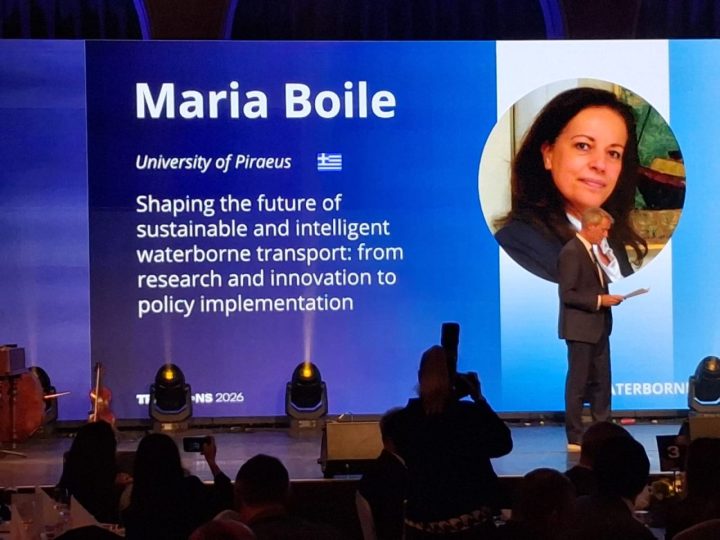
Study by Maria Boile and Vasiliki Maria Perra links short sea shipping with territorial cohesion and insularity
Professor Maria Boile, a Corresponding Member of Komvos, and researcher Vasiliki Maria Perra have authored a new study on the relationship between maritime connectivity and territorial cohesion in the Greek islands. The paper was published on 14 September 2026 in European Transport Research Review.
The study, entitled “A composite indicator to support short sea shipping and territorial cohesion in Greek Island regions”, develops a framework for assessing island ferry connections using specific connectivity and accessibility indicators.
Territorial cohesion concerns the reduction of spatial and socioeconomic inequalities and balanced access to services, transport and economic opportunities for residents and regions.
An index for island connectivity
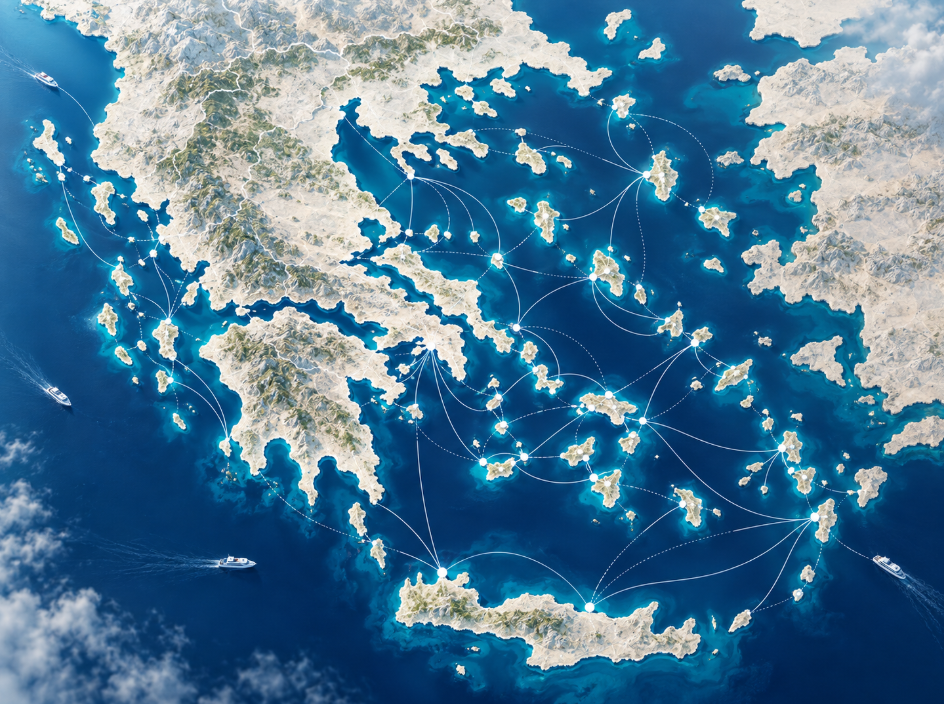
The research by Vasiliki Maria Perra and Maria Boile focuses on short sea shipping, particularly passenger maritime transport between the Greek islands and the mainland.
The authors develop the Island Territorial Cohesion Index (ITCI), a composite indicator framework linking maritime transport performance with territorial cohesion in island regions.
The study’s empirical application examines two key dimensions for which harmonised data are available: connectivity and accessibility. These are assessed using measures such as the number of direct connections, service frequency, passenger capacity, travel time and transport costs.
The analysis uses 2018 data covering 72 Greek islands. This year serves as a baseline, allowing the methodology to support future comparisons.
The data come from the Integrated Database on Short Sea Shipping Network (EVDAD), developed by the Hellenic Institute of Transport at the Centre for Research and Technology Hellas (CERTH) to support the Ministry of Maritime Affairs and Insular Policy.
What does the study reveal about the Greek islands?
The results show substantial differences between islands in terms of connectivity and accessibility. The analysis enables comparisons of each island’s performance and identifies specific weaknesses in the maritime transport services provided.
According to the publication, Crete has the highest number of direct connections, with 23 port-to-port links, while other islands have considerably lower levels of connectivity.
The study concludes that the proposed framework can be used to benchmark islands, identify differences in service provision and prioritise interventions in short sea shipping.
The authors also note that the methodology can be applied to other island or coastal regions beyond Greece.
The two researchers behind the study
Maria Boile is a Professor in the Department of Maritime Studies at the University of Piraeus, specialising in the management and policy of ports and intermodal terminals.

She also heads a unit covering Transport Economics and Environment, Maritime and Air Transport, and has more than 25 years of academic and research experience in the United States and Europe.
Maria Boile is a Corresponding Member of Komvos and Coordinator of the European Waterborne Technology Platform.
Vasiliki Maria Perra is a researcher at CERTH’s Hellenic Institute of Transport and collaborates with the Laboratory of Quantitative Analysis in Shipping at the University of Piraeus. Her research covers short sea shipping, maritime spatial planning, insularity and the assessment of maritime transport systems.
Both researchers are affiliated with the University of Piraeus and the Centre for Research and Technology Hellas (CERTH).
The relationship with shipping and insularity
The research examines the role of maritime transport in island regions, particularly its relationship with residents’ access to services and economic activities.
The study describes Greece’s domestic short sea shipping network as one of Europe’s largest and most complex island transport networks. It comprises approximately 180 island ports, served by main and local routes connecting the islands with one another and with mainland Greece.
Measuring connectivity, service frequency, travel time and costs can support transport policy planning and the assessment of services provided under public service obligations.
How does the research relate to the Komvos initiative?
Maria Boile serves on the Shipping Advisory Committee of the Komvos initiative for the Green Transition in the Maritime Sector.
The initiative covers short sea shipping, insularity, port infrastructure, fleet renewal, and the green and digital transition of maritime transport.
The new study by Boile and Perra contributes a measurable framework for assessing connectivity and accessibility in the Greek islands, with potential applications in comparative analysis and policy planning.
The article was published with open access in European Transport Research Review, with support from the European TRA2026 project.