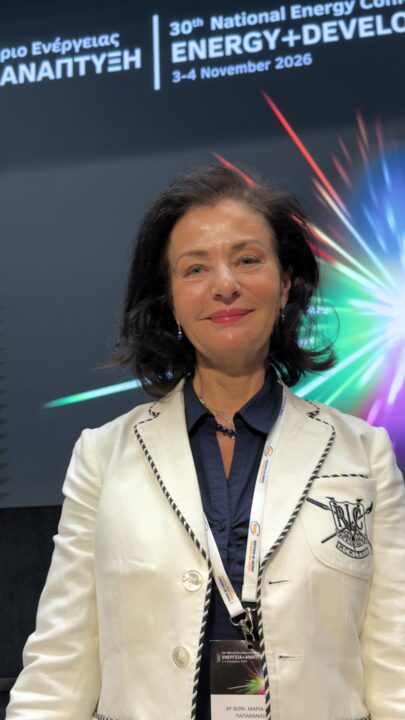
Marie-Athena Papathanasiou, international environmental lawyer, IENE Research Fellow, Director of Ecoprosperity Capital Ltd and Corresponding Member of Komvos, presented opportunities for Greek shipping and industry at the IENE conference.
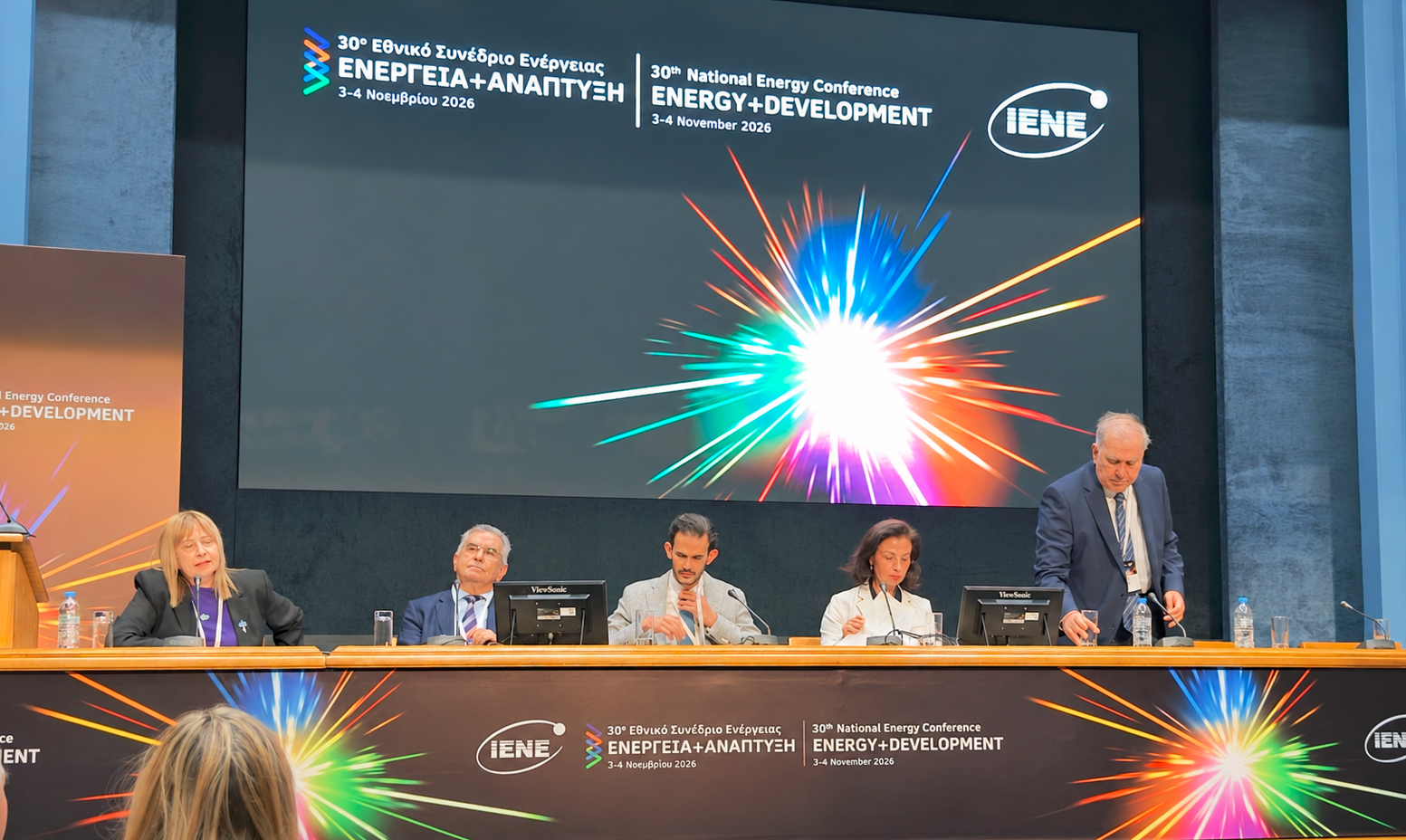
Nuclear propulsion, floating power plants and the participation of Greek companies in developing specialised equipment and services bring a distinct dimension to Greece’s discussion on nuclear energy. These were the prospects explored by Marie-Athena Papathanasiou, a Corresponding Member of Komvos, during the session “The Promise of Nuclear Energy” on 4 November 2026 at the Eugenides Foundation.
The session formed part of the 30th Annual National Conference “Energy and Development 2026”, organised by the Institute of Energy for South-East Europe (IENE). The contributions highlighted differing assessments of costs and technological readiness, alongside the conditions required for potential deployment.
What opportunities could emerge for Greek shipping?
Marie-Athena Papathanasiou argued that Greece’s position in international shipping offers an opportunity to play a substantive role in developing nuclear applications.
On propulsion, she focused on specific categories of large vessels for which energy autonomy, fuel costs and lower operational emissions could offer long-term advantages. The economic prospects of these applications need to be assessed against the characteristics and requirements of each vessel category.
She placed particular emphasis on opportunities for Greek companies to participate in manufacturing specialised components, control systems, maintenance and technical services. These activities could connect the country’s maritime strength with domestic production and expertise.
She also highlighted floating nuclear power plants, outlining potential applications in supplying electricity to ports, desalination and meeting the energy needs of industrial facilities and data centres.
She linked the sector’s development to research and education, stressing the need for specialised personnel and the opportunity to attract scientists from abroad.
Costs and commercial maturity
Konstantinos Mathioudakis, Professor at the National Technical University of Athens (NTUA) and Director of its Laboratory of Thermal Turbomachines, addressed the economic considerations in his opening presentation. He discussed delays in nuclear power plant construction and overruns of initial budgets.
For Greece, he questioned whether the need for additional nuclear capacity had been sufficiently substantiated, taking into account the potential for energy savings, renewable energy development, storage and other domestic energy resources.
Dionysis Chionis, Co-founder of Athlos Energy, distinguished between the technological and commercial maturity of small modular reactors, known as SMRs. He explained that some designs draw on the technology and experience of large reactors, while their commercial deployment remains at an early stage.
For Greece, he identified safety, prior construction of the selected technology in other countries and a reliable supply chain as key criteria.
A national position and independent oversight
Christos Housiadas, Chairman of the Greek Atomic Energy Commission (EEAE), outlined the assessment process based on the methodology of the International Atomic Energy Agency. He emphasised the importance of establishing an evidence-based national position before proceeding to preparation and potential implementation.
A central question concerns the intended use: electricity generation for the grid, shipping, industrial heat and supplying specific facilities each create different requirements for infrastructure, financing, personnel and the institutional framework.
Returning to oversight, Marie-Athena Papathanasiou stressed the need to safeguard the EEAE’s independence from government energy policy and economic interests. The regulator’s responsibility, she noted, is to ensure the safety of nuclear applications and facilities.
The discussion was moderated by Sofia Politopoulou, an executive at the Hellenic Electricity Distribution Network Operator (HEDNO) and a member of IENE’s Executive Committee.
Marie-Athena Papathanasiou holds a doctorate in International Comparative Law from Paris II – Sorbonne University and has experience as legal counsel in shipping, infrastructure and clean energy. She is a Corresponding Member of Komvos and serves on the Advisory Committee of its “Tourism and Sustainability” initiative.