Samantha Cristoforetti and Adrianos Golemis, a Partner of Komvos, spoke at the Eugenides Foundation about their missions, the value of collaboration and the preparation behind every flight.
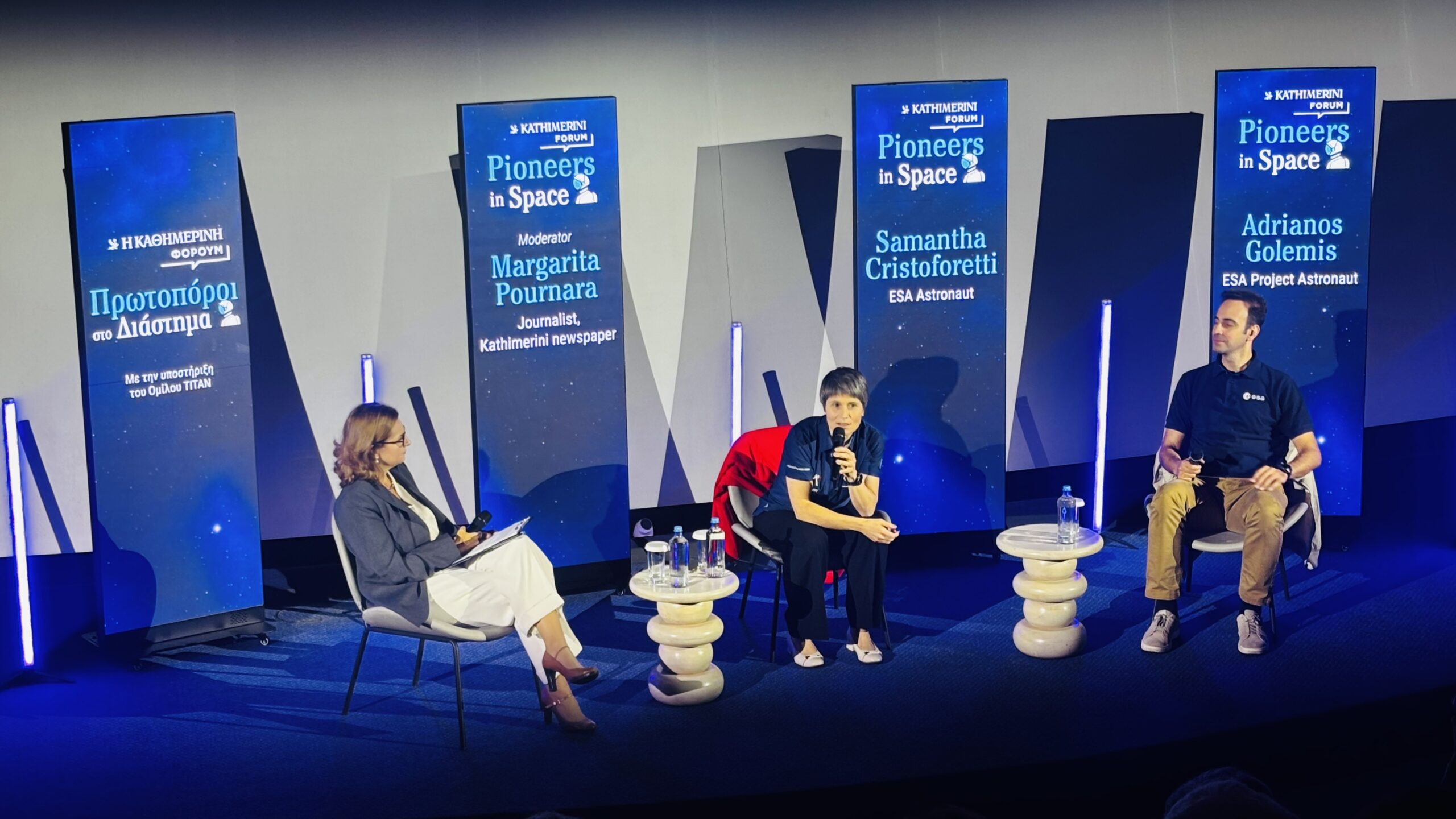
At an engaging event at the Planetarium of the Eugenides Foundation, Samantha Cristoforetti and Adrianos Golemis shared stories from their journeys in space exploration. Held on Thursday, 15 October 2026, “Pioneers in Space” combined presentations by the two astronauts with a discussion moderated by Margarita Pournara, bringing together scientific insight, humour and personal reflections.
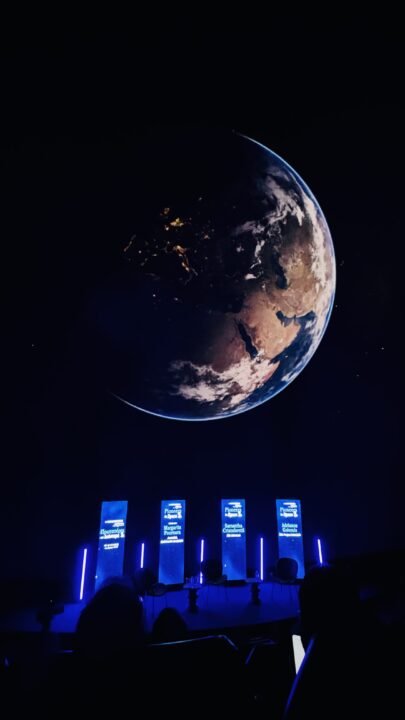
The occasion stemmed from an invitation by TITAN Group to Samantha Cristoforetti to speak at its annual management meeting in Athens. The public event was organised by Kathimerini, with the Group’s support, giving the audience an opportunity to meet two people at different stages of their journeys in space.
Samantha Cristoforetti describes life in orbit
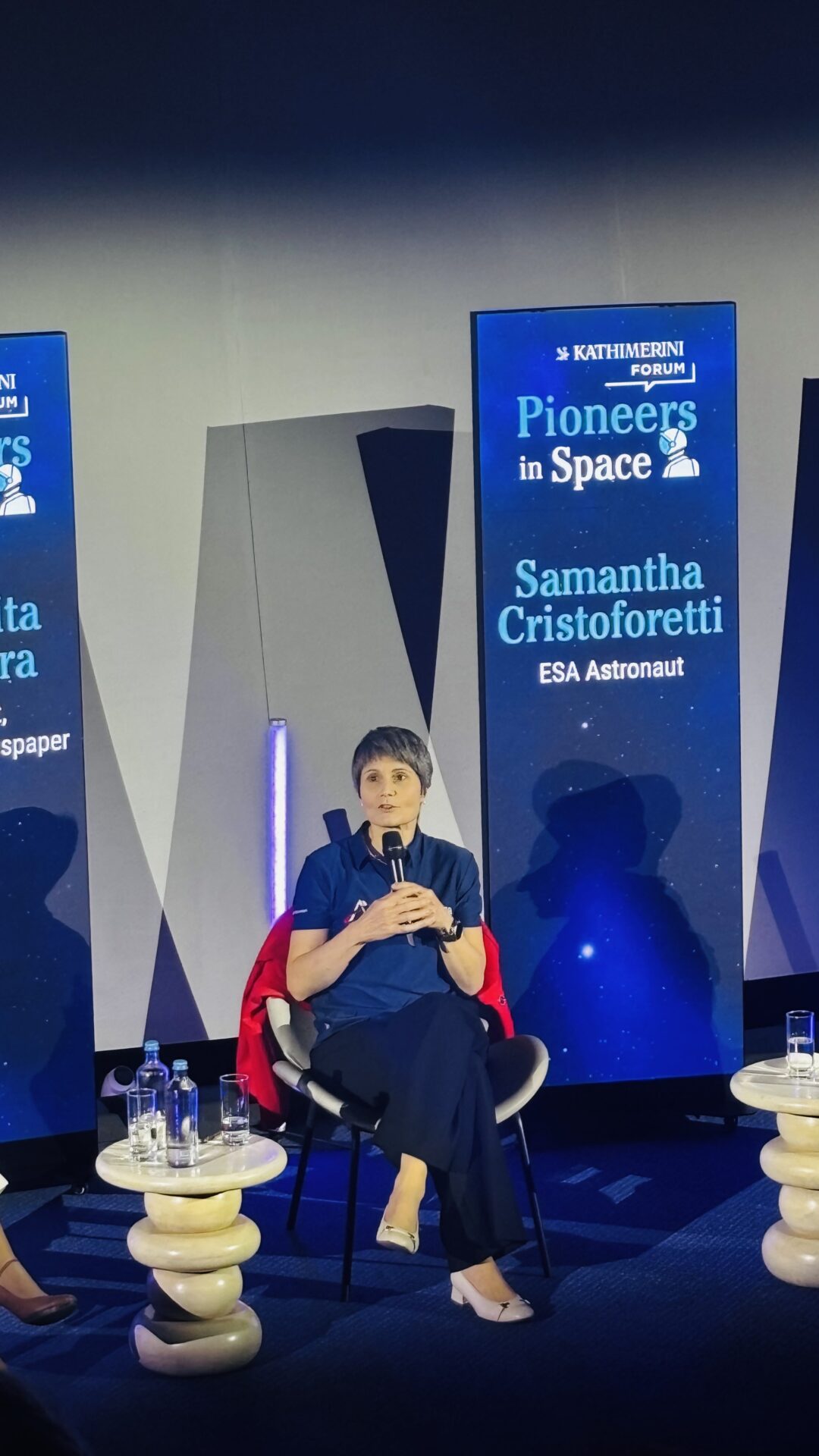
The first speaker was Samantha Cristoforetti, an astronaut with the European Space Agency (ESA) and the first European woman to command the International Space Station. A “good evening” in Greek and a remark that she might visit Greece more often now that she had a Greek colleague set a warm tone for her presentation. She then traced her journey from childhood in the Alps to her two space missions, Futura and Minerva.
In the small village where she grew up, Space Shuttle flights and Captain Kirk’s television adventures fuelled her childhood imagination. Her interest in science and engineering led her to study aerospace engineering, join the Italian Air Force and, eventually, be selected by ESA.
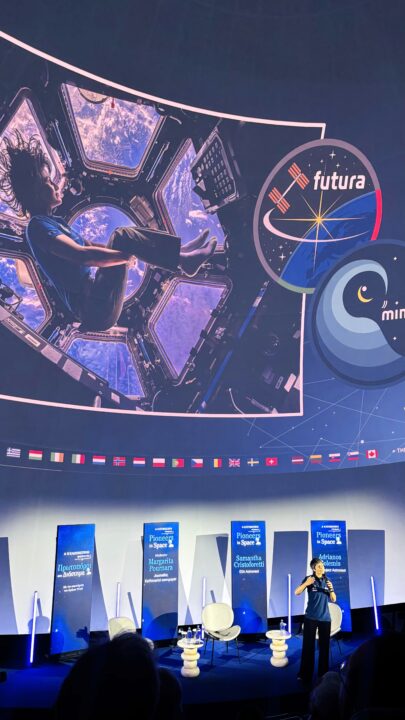
Energetic and direct, the Italian astronaut explained things precisely without losing her sense of humour. She described her second flight, aboard the newer and more spacious Crew Dragon, as an upgrade to first class compared with the cramped interior of the Soyuz spacecraft used for her first mission.
Images of launches, experiments and everyday work aboard the International Space Station filled the Planetarium dome. How does water behave in microgravity? Can you drink coffee from an ordinary cup? Alongside the scientific explanations, she described maintenance tasks and the demands of a schedule that leaves little free time.
Her presentation ended with a photograph of Athens that she had taken from space on 27 August 2022. Anyone who had been in the city that day, she joked, could wave to themselves in the picture.
Adrianos Golemis returns to the Planetarium
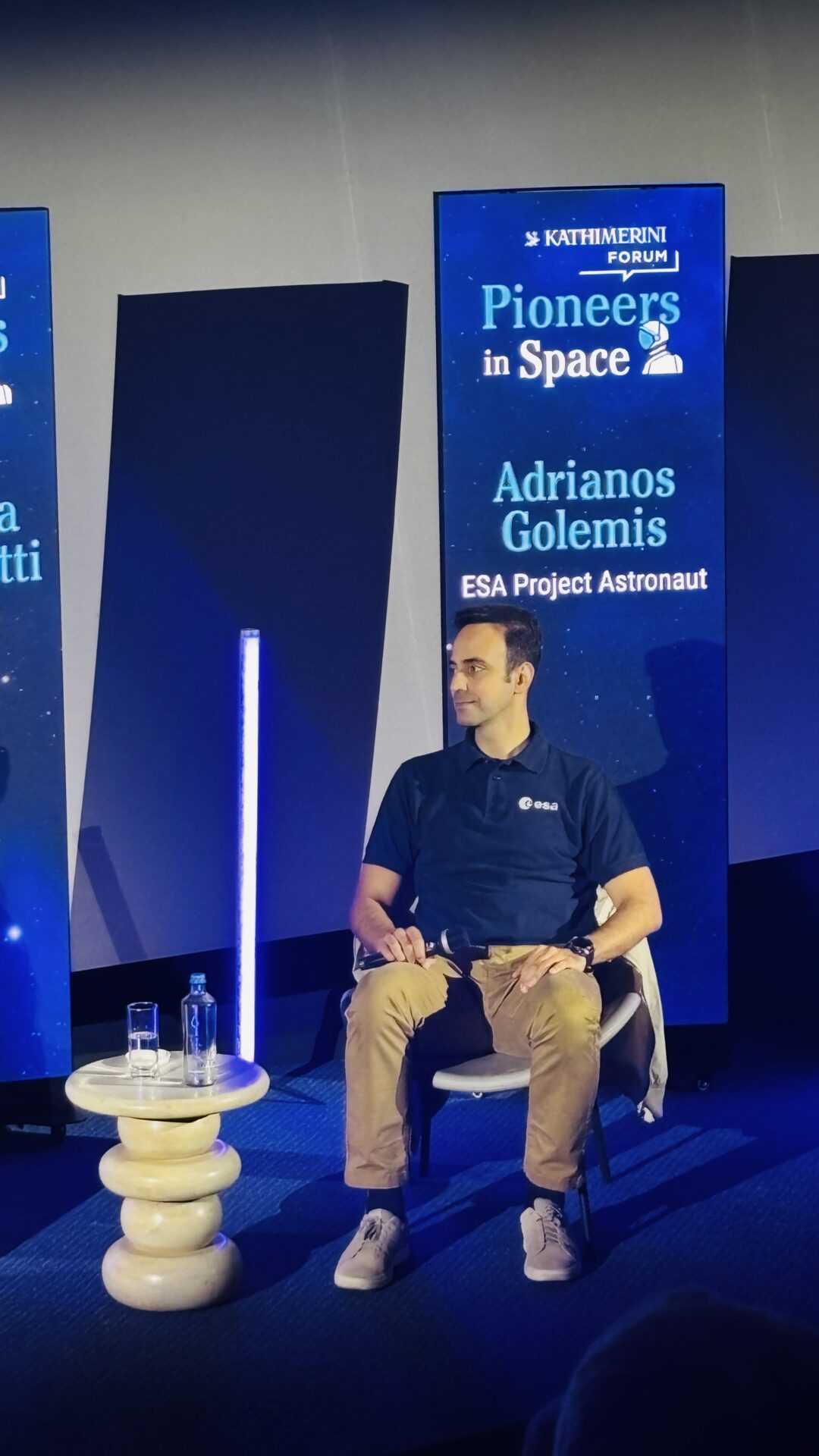
Adrianos Golemis, a Project Astronaut at the European Space Agency (ESA) and a Partner of Komvos, began with a memory connected to the venue. He had visited the Planetarium around 2005 as a pupil on a school trip from Larissa, after two sleepless nights with his classmates.
The comfortable seats and darkened dome made staying awake a challenge. “I think I was the only one who didn’t fall asleep,” he recalled.
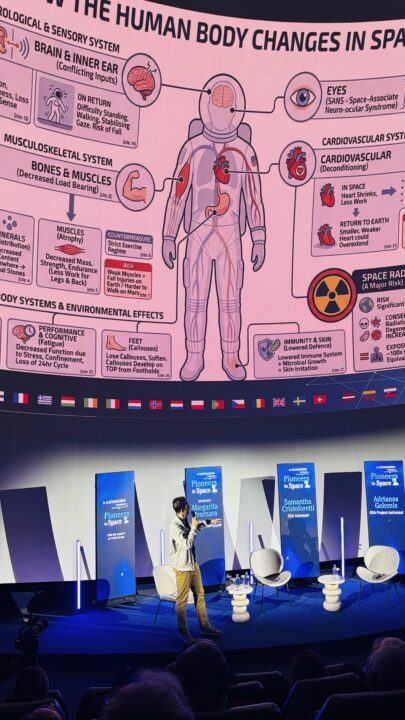
This time, the Greek astronaut was returning to the Planetarium to present the preparations for his own space mission. He recounted his journey calmly, with self-deprecating humour and without grand statements.
His account continued with his medical studies, his specialisation in space sciences and his stay at the Franco-Italian Concordia research station in Antarctica. There, he studied the effects of isolation and extreme conditions on the human body, gathering knowledge relevant to space missions.
As a doctor, Adrianos Golemis supported European astronauts during their preparations, flights and return to Earth. They included Samantha Cristoforetti herself and Thomas Pesquet, with whom he is now preparing to fly on the same mission. These experiences had given him first-hand knowledge of how a mission works before he began training for his own.
Using a slide illustrating the changes that spaceflight causes in the human body, he also explained the role of space medicine: prevention, monitoring astronauts’ health and supporting their adaptation during flight and after their return.
Discussing plans for his flight in 2027, he described approximately two weeks of intensive work aboard the International Space Station, conducting experiments from Greece and elsewhere in Europe. He also returned to the purpose of this effort: the scientific knowledge brought back to Earth and the opportunities opening up for the Greek space ecosystem.
Also attending the event was Anezina Solomonidou, Mission Manager for the Greek side of the mission and a member of Komvos’ International Advisory Committee, who followed Adrianos Golemis’s presentation on the mission’s preparations and objectives.
What lies behind a journey into space?
Following the presentations, Kathimerini journalist Margarita Pournara invited the two speakers into a discussion that connected their professional choices with more personal questions. Their contrasting temperaments added interest to the exchange: Samantha Cristoforetti responded with directness and determination, while Adrianos Golemis spoke with measured confidence and an awareness of the difficulties along his path.
The moderator began by asking Samantha Cristoforetti what she would prefer to be asked instead of the familiar question about being a woman astronaut. The Italian astronaut acknowledged the public’s interest while expressing the hope that, over time, gender would no longer prompt the same need for explanation.
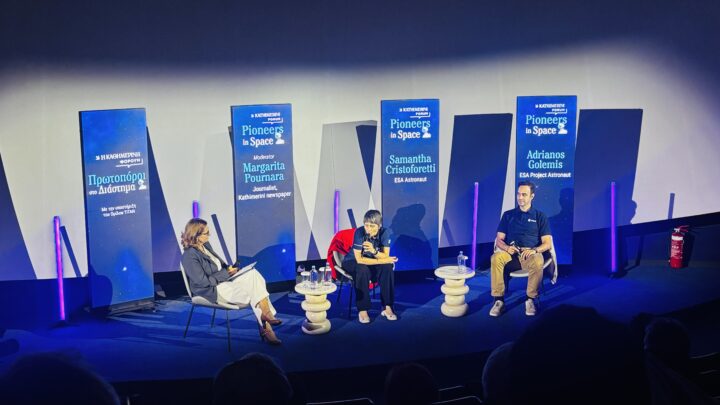
Turning to Adrianos Golemis, the journalist raised the question of opportunity. What would he say to a young person with big ambitions who feels they lack a privileged social or financial background?
“We should not put obstacles in our own way because we believe the conditions are not ideal,” he replied.
The Greek astronaut acknowledged that effort does not always bring rewards, noting that his own attempts had not always produced the desired results. Looking back ten or fifteen years, he could not have predicted how all the steps in his journey would connect. What he could do, however, was prepare and keep testing his abilities.
The discussion also turned to Europe’s position in space. Samantha Cristoforetti argued for stronger European capabilities so that Europe could play a meaningful role in partnerships and decisions concerning future space infrastructure. Adrianos Golemis linked the Greek mission to the country’s progress in the sector, stressing the importance of continuity and closer cooperation between science and industry.