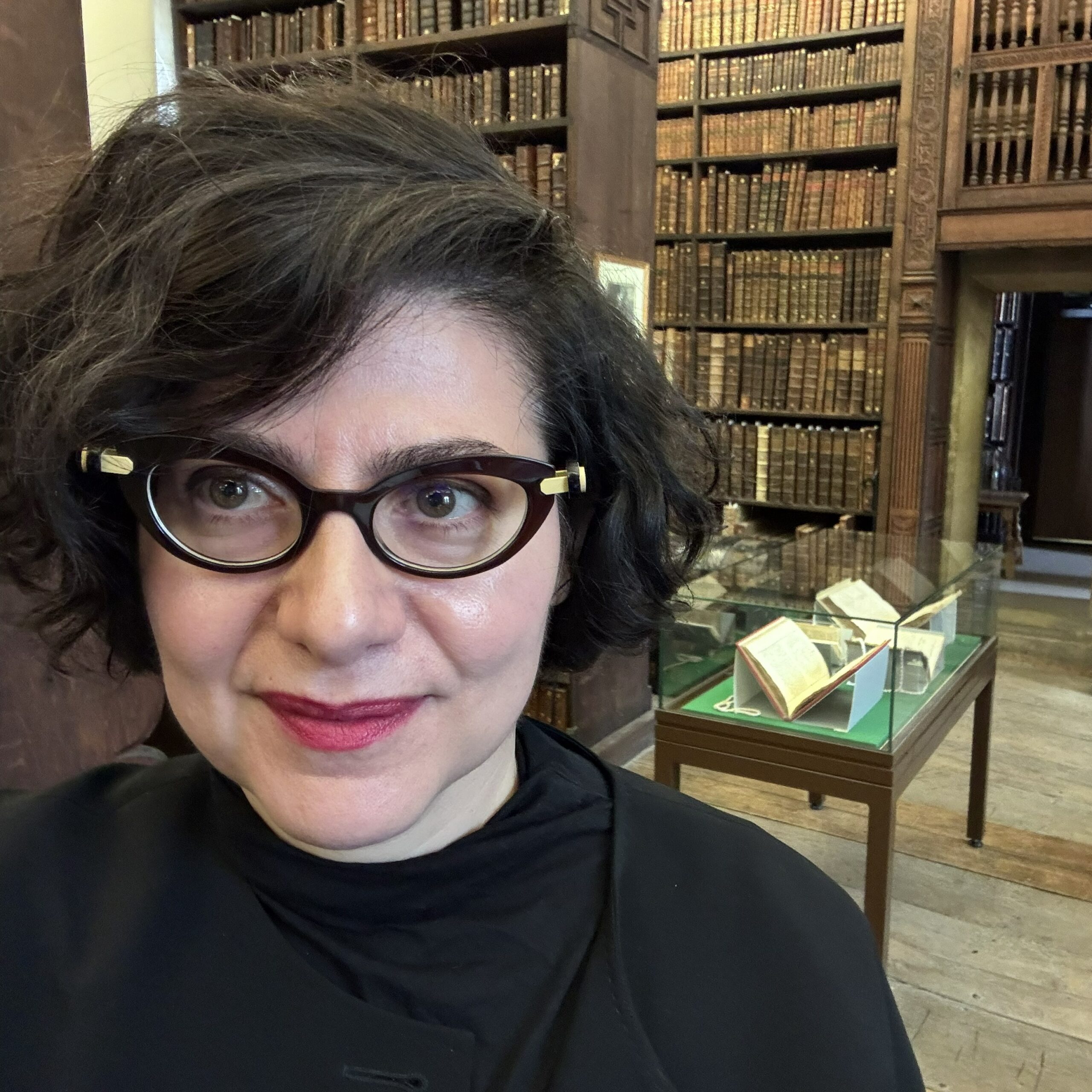
Ioanna Sitaridou is Professor of Spanish and Historical Linguistics at the University of Cambridge, Co-Director of the Cambridge Centre for Greek Studies, and Fellow of Queens’ College, Cambridge. She served as Head of the Section of Spanish and Portuguese at Cambridge from 2019 to 2021 and is President-Elect of the Societas Linguistica Europaea (2026–2029). She is also Co-Editor-in-Chief of Glossa Contact and has held visiting appointments at institutions including INALCO in Paris, Harvard, Princeton, Oslo, the Federal University of Bahia in Salvador (Brazil), and the University of Chicago.
Her research examines how languages evolve, interact, and survive, integrating insights from historical and comparative linguistics, syntactic theory, language acquisition, and sociolinguistics. Focusing on the Romance languages and Greek, she critically reassesses established accounts of language change through fine-grained comparative analysis and the systematic reconstruction of sociohistorical conditions. This approach allows her to develop explanatory models grounded in the mechanisms of language acquisition, shedding light on how linguistic changes emerge and spread.
For nearly two decades, she has conducted fieldwork on Romeyka, an endangered Greek variety spoken in Turkey, whose distinctive grammatical features offer new evidence for the history of Greek and the mechanisms of linguistic change. Her research also extends to endangered and marginalised languages in Gibraltar, Sri Lanka, and Greece, connecting theoretical inquiry with community-centred language documentation.
Beyond academia, her work explores the relationship between language, identity, cultural heritage, and social inclusion. Through public engagement and collaboration with speaker communities, she seeks to challenge linguistic marginalisation, promote the value of multilingualism, and demonstrate how linguistic diversity contributes to cultural richness and social cohesion.