Dr Anezina Solomonidou on the relationship between art and science, technology as both a tool and a form of power, and the question of whether humanity will carry into space the same mistakes it has already made on Earth.
What can cinema and space possibly have in common?
More than might appear at first glance.
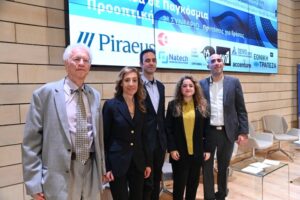
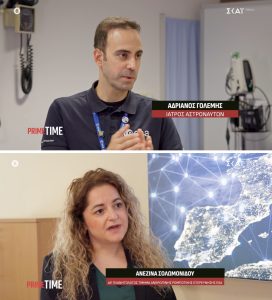
Dr Anezina Solomonidou knows both sides of this relationship well. A planetary geologist and Senior Scientist at the Hellenic Space Center, with many years of research experience at NASA/JPL, Caltech and ESA and involvement in major space missions, she is a member of Komvos’ International Advisory Committee and of the team behind its Space Science, Technology and Industry initiative.
She also represents Greece at ESA in Human and Robotic Exploration and is mission lead for the Greek side of the PAM-6 mission, in which Adrianos Golemis, Corresponding Member of Komvos, will travel to the International Space Station as a Mission Specialist.
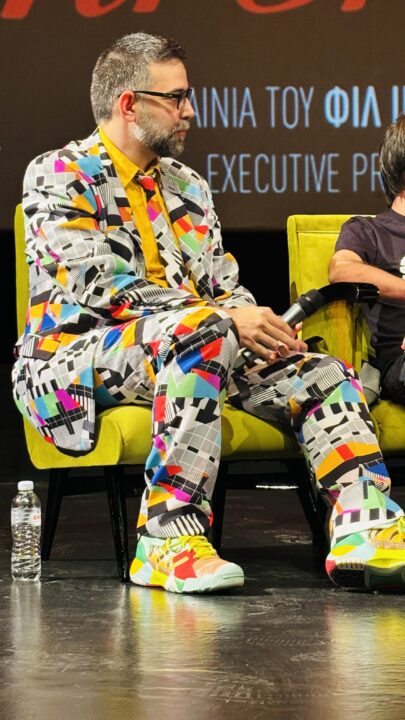
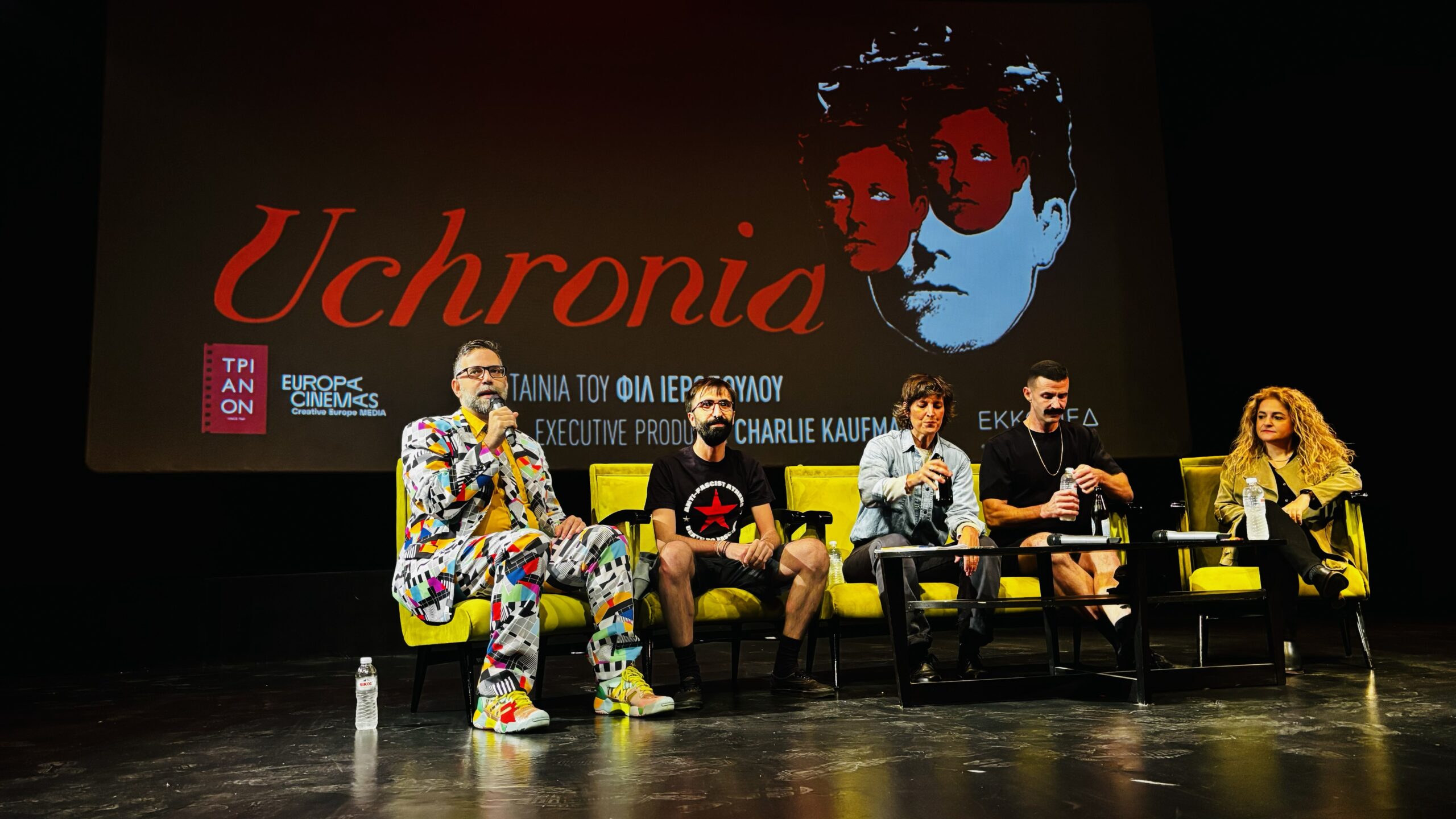
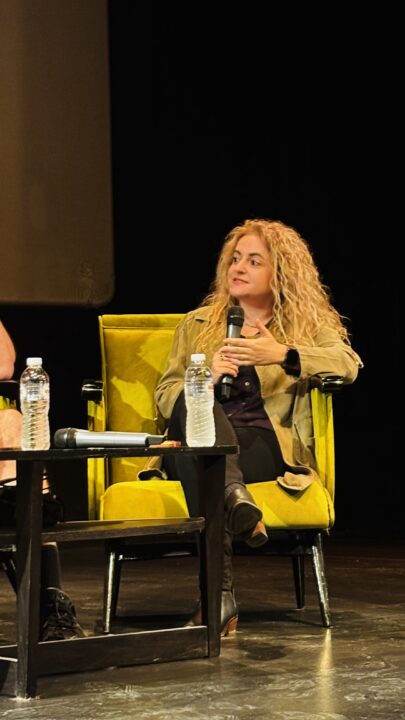
And yet, on Wednesday, 30 September, the discussion did not take place at a scientific conference or a space research centre, but at the Trianon cinema. 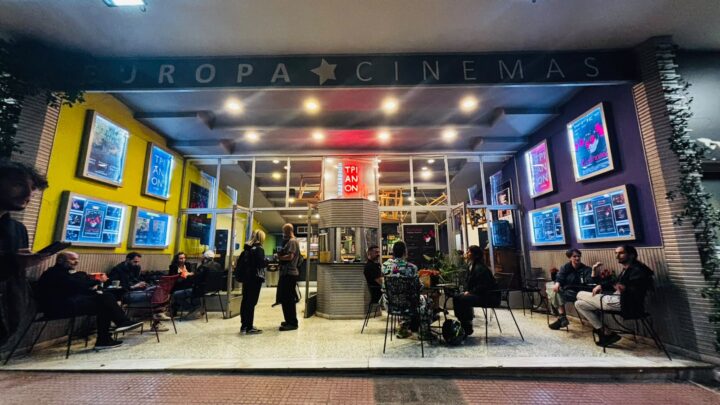 Before the screening of Uchronia, directed by Fil Ieropoulos, Anezina Solomonidou joined researcher Jacopo Mosesso, artist and architect Sofia Dona, and actor and writer Macklin Kowal in a discussion entitled “From Marinetti to Elon Musk: technological anachronisms, nostalgic futurisms”.
When a Film Can Create a Scientist
For Anezina Solomonidou, the connection between cinema and space is also personal. It was the film Contact that, when she was still very young, made her fall in love with space and ultimately led her to pursue science.
She does not regard her experience as unique. As she noted during the discussion, many scientists and engineers chose their path because a film or a story they encountered as children, teenagers or even adults opened up a world they had never previously imagined.
In this sense, art does not simply portray science. It can come first. It can spark wonder, curiosity and, ultimately, the desire to discover whether something that belonged to the realm of imagination until yesterday might actually become possible.

This is where the transition from STEM — Science, Technology, Engineering and Mathematics — to STEAM, with the addition of the A for Arts, becomes particularly meaningful. Art, creativity and the humanities enter the conversation alongside science and technology.
This relationship is not merely decorative. Science and art can each serve as a source of inspiration for the other.
How much “science” should there be in science fiction?
The relationship between science and cinema also works in the opposite direction. Cinema helps us imagine the unknown, while our growing knowledge of the Universe constantly shifts the boundaries of that imagination.
Anezina Solomonidou offered a telling example during the discussion: when a science-fiction film imagines life on other planets solely in terrestrial terms, it projects our own assumptions about biology and the conditions necessary for life. Yet we need only move relatively little beyond Earth to realise that many of these certainties are far from self-evident.
The Universe does not change; our understanding of it does.
And the more we learn, the more tools science fiction gains to go one step further. She also suggested that artificial intelligence could contribute to our understanding of complex physical phenomena and, consequently, enrich the ways in which we imagine other worlds.
Perhaps this is one of the great strengths of science fiction: the ideas it contains may precede reality. As Anezina Solomonidou observed, many of them resemble things that are simply “waiting to happen”.
What happens when technology becomes power?
From cinema, the discussion inevitably moved to technology itself — and to a far more difficult question.
For Anezina Solomonidou, there is a fundamental difference between technology as a tool and technology as a form of power.
Technology, when disconnected from scientific knowledge and scientific ethics, can acquire enormous power. This is particularly the case when technology, information, data and the ability to influence the rules governing their use are concentrated in the same centres.
The question then ceases to be simply “what can we do?”
It also becomes: who decides what we do, on what terms and with what responsibility?
And this question does not stop at the boundaries of Earth. On the contrary, it becomes even more compelling when we consider the future of humanity’s presence in space.
Colonisation or settlement in space?
At this point, Anezina Solomonidou placed particular emphasis on the distinction between colonisation and settlement.
Colonisation is not a neutral term. Humanity has already applied models of conquest, appropriation and exploitation on Earth and knows their consequences. The question is why we assume that transferring the same logic beyond Earth would produce a different outcome this time.
Anezina Solomonidou was clear about the risk: discussions around the new era of space exploration are increasingly adopting the language of colonisation, even though history has already shown us where this logic can lead.
“If we have not learned from the mistakes we made on Earth, why should we expect ourselves to behave differently beyond it?”
Settlement, by contrast, can describe a different approach: one in which we explore, use and even inhabit a place without automatically assuming that it must be conquered or that it belongs to us.
This is more than a difference in terminology. It reflects a different way of thinking about how we want to expand the human presence beyond Earth.
Space exploration already has an environmental cost
And this discussion is not theoretical. The first consequences of this expansion are already visible.
Space technology provides enormous benefits: satellite communications, navigation, scientific observation, microsatellites, the transport of materials to the International Space Station, and medical and physiological experiments.
But there is also a cost.
Referring to a celestial phenomenon following a Falcon 9 launch, observed in August 2026 by artist and architect Sofia Dona and described during the panel, Anezina Solomonidou explained that heavy rocket launches leave residues and particles in the atmosphere. At the same time, tens of thousands of satellites and other objects are already orbiting Earth, many of them no longer operational.
Pollution, therefore, is no longer confined to the Earth’s surface or atmosphere. It is gradually extending into the space around our planet.
This brings us back to Anezina Solomonidou’s original point: we have one Earth, but we also have one solar system. Expanding human activity into it does not mean that the consequences disappear once we cross the limits of the atmosphere.
What future do we want to create?
Perhaps, then, the real question connecting cinema and space is not simply “what will the future look like?”, but “what future do we want to create?”
Science fiction allows us to test the future before it exists. It enables us to imagine new technologies, new worlds and different forms of human presence. Science, in turn, shows us which of these are possible — and often goes on to surpass even our imagination.
But that is not enough.
Alongside “can we?” there is always “should we?”. Alongside exploration, there is responsibility. Alongside technological capability, there is the need to decide how we want to use it.
And somewhere at that point, science meets art once again: the former shows us what can be done; the latter helps us imagine what is worth doing.