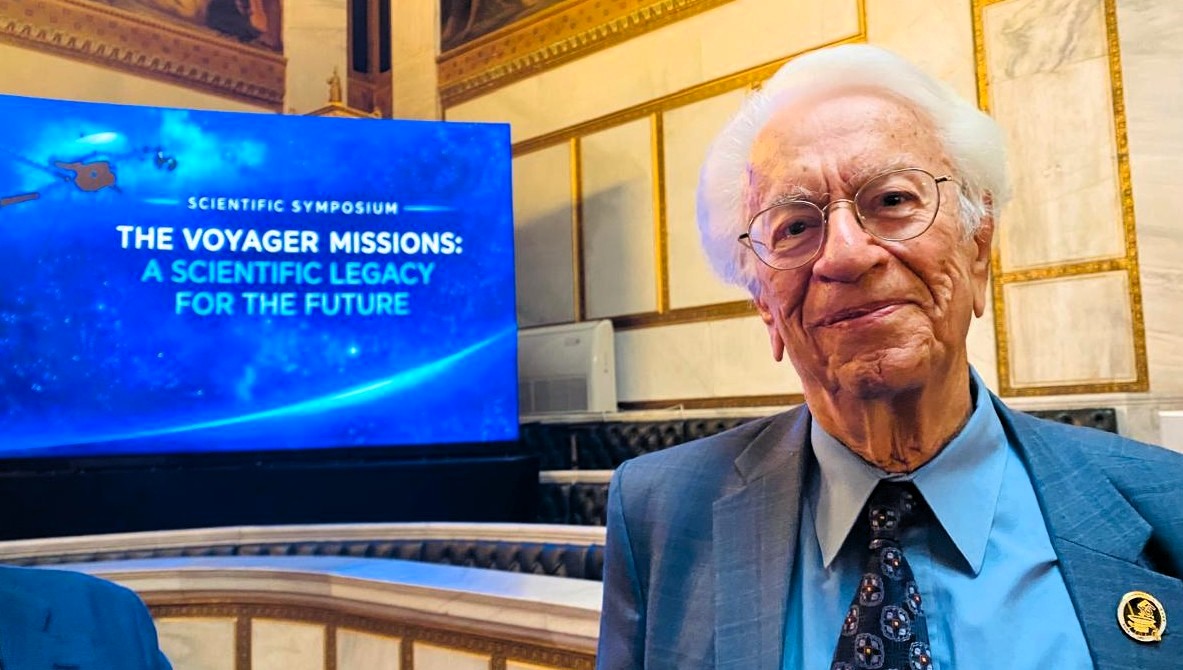
At the Academy of Athens, leading figures in space exploration shared the story of the missions and discussed their scientific legacy and Greece’s contribution.
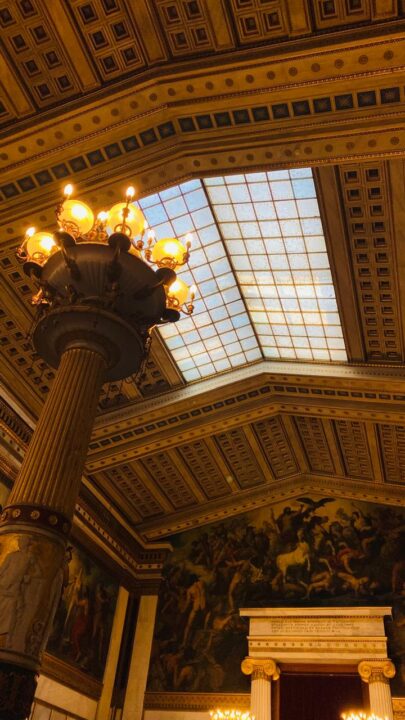
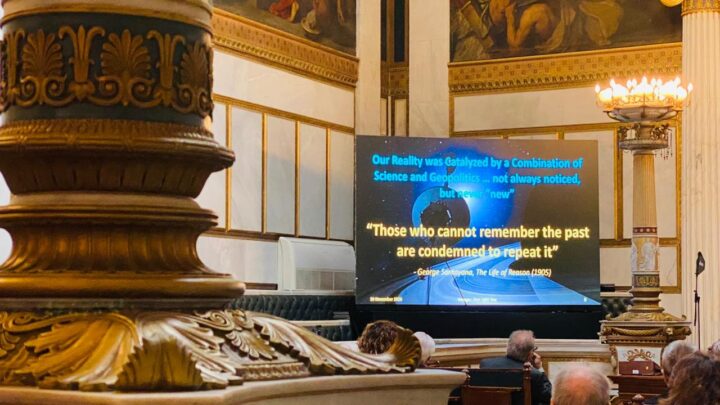
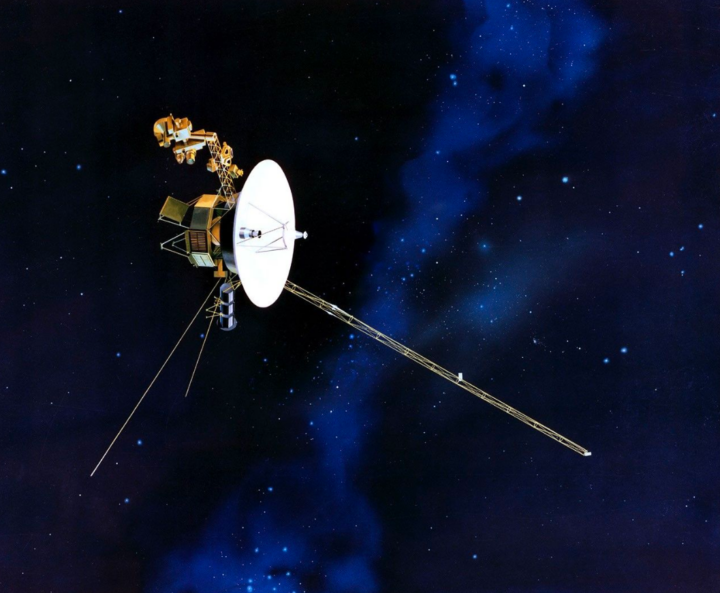
Nearly half a century after their launch, the Voyager spacecraft continue to expand our understanding of space. Their journey, discoveries and the people who made them possible were the focus of the “Voyager – One Light-Day” symposium, held on 10 November 2026 at the Academy of Athens.
The gathering took place just days before a remarkable milestone. On 18 November, Voyager 1 is expected to reach a distance of approximately 26 billion kilometres from Earth, where light takes 24 hours to travel between the spacecraft and our planet. From their launches in 1977 and encounters with the outer planets to their exploration of interstellar space, the two missions have far exceeded their original objectives.
Athens hosted a rare gathering of past and present leaders of NASA’s science programmes alongside key figures behind the Voyager missions. Joining in person and remotely, different generations of space exploration discussed crucial decisions, the uncertainties of research and the relationship the public developed with the mission.
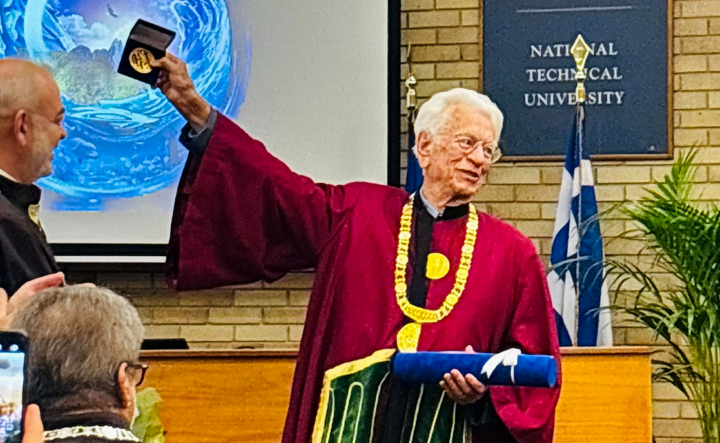
The symposium was organised by the Center for Space Research and Technology under the auspices of the Academy of Athens. Its scientific organisers were Stamatios Krimigis, the Center’s supervisor and a former President of the Academy, and Konstantinos Dialynas, its Acting Director. Mathematician and Academy member Athanasios Fokas opened the event on behalf of the Academy. Science journalist Nadia Drake moderated the proceedings. She is the daughter of astronomer Frank Drake, known for the equation bearing his name concerning the search for extraterrestrial civilisations.
The symposium was supported by the Ministry of Digital Governance and Artificial Intelligence and the General Secretariat of Telecommunications and Post, with To Vima as media sponsor.
The speakers included Komvos Partners Stamatios Krimigis and Athena Coustenis, initiators of the “Space Science, Technology and Industry” initiative — Komvos.Space. Their participation connected the history of major missions with Greece’s current contribution to international space research.
A Habitable Astrosphere: Voyager’s History, Legacy and Science
Ralph McNutt Jr.: How Did the Grand Journey Become Possible?
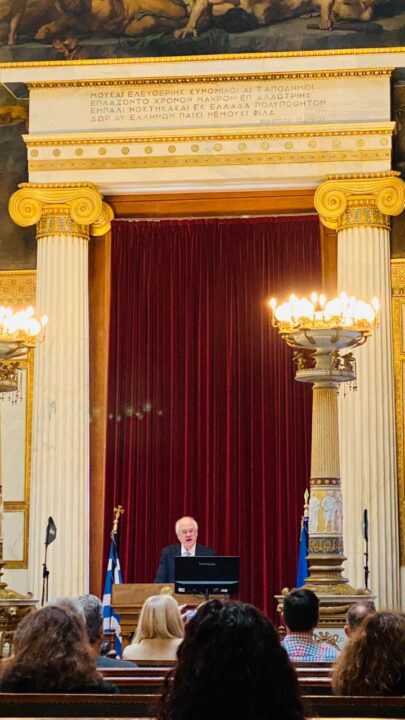
Ralph McNutt Jr., Chief Scientist for Space Science at the Johns Hopkins University Applied Physics Laboratory, opened the talks with the history of Voyager. A member of the science teams for both spacecraft, with involvement in MESSENGER, Parker Solar Probe and New Horizons, he has devoted much of his career to exploring the Solar System.
His account returned to the 1960s, when the idea of the “Grand Tour” was taking shape. The positions of Jupiter, Saturn, Uranus and Neptune in the late 1970s offered a rare opportunity: a spacecraft could encounter them in succession, using each planet’s gravity to change its trajectory and speed towards the next. Such a favourable alignment recurs approximately every 175 years.
Taking advantage of this opportunity required new trajectory calculations, robust systems and scientific instruments for a journey of unprecedented duration. Ralph McNutt Jr. traced the project’s development amid scientific ambition, geopolitical competition and limited resources. The proposal faced challenges and revisions before taking the form of the missions launched in 1977.
A historic photograph of the first meeting of the Mariner Jupiter Saturn science team at JPL in 1974 included a young Stamatios Krimigis. It captured a moment of preparation, when the worlds Voyager would reveal were still distant destinations.
The discoveries exceeded expectations. Active volcanoes on Io, an icy surface crisscrossed by fractures on Europa, geysers on Triton and unexpected magnetic fields transformed scientists’ understanding of the outer planets and their moons. Voyager 2 eventually reached all four giant planets, providing what remain the only close-up spacecraft observations of Uranus and Neptune.
The talk continued through Galileo and Cassini to the more recent Europa Clipper and Juice missions. Questions opened up by Voyager led to new missions and continue to guide space exploration.
Lennard Fisk: The Mission Had to Continue
Lennard Fisk, Professor Emeritus at the University of Michigan and a former NASA Associate Administrator for Space Science and Applications, approached Voyager’s history through the decisions that secured its continuation. Having held leadership roles at COSPAR and the US National Academies’ Space Studies Board, he knows first-hand how scientific priorities become programmes.
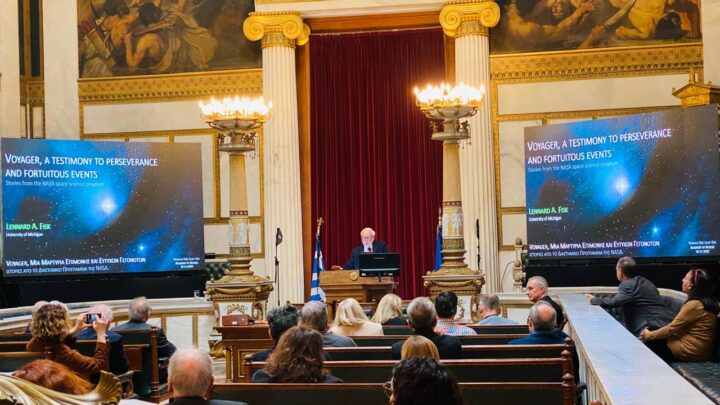
His talk explored the perseverance and unforeseen circumstances that proved decisive for the mission. Behind the spacecraft’s nearly fifty-year journey were moments when their future was anything but assured.
One such moment came in 1989. Voyager 2 had reached Neptune, completing its tour of the four giant planets. A major chapter in planetary exploration was closing. Yet the spacecraft were still operating and heading towards a region no other spacecraft had studied at close range.
Lennard Fisk described how transferring the programme from planetary science to solar and space physics allowed its funding to continue. The mission acquired a new direction: to follow the Sun’s gradually diminishing influence and explore where the solar wind meets the interstellar environment.
That decision enabled Voyager to continue for decades beyond its final planetary destination. The measurements that followed became one of the mission’s most important chapters, well beyond its original horizon.
Konstantinos Dialynas: What Do Voyager’s Measurements Reveal?
Konstantinos Dialynas, Acting Director of the Academy of Athens’ Center for Space Research and Technology, presented Voyager’s scientific achievements from 1977 to 2026. A Co-Investigator on the spacecraft’s LECP experiment, he also participates in the Cassini–Huygens and Juice science teams, connecting decades of research with today’s missions.
His talk focused on particle measurements collected throughout Voyager’s journey. Changes in particle energy, composition and direction allow scientists to reconstruct what is happening around the spacecraft, even where a photograph could not provide an answer.
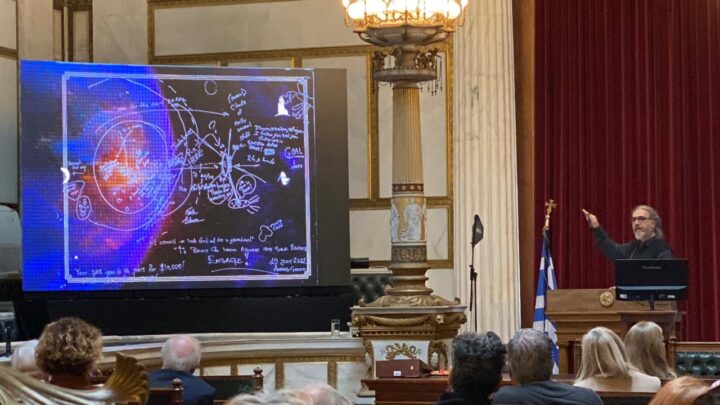
A crucial contribution comes from the Low Energy Charged Particle experiment, or LECP, developed by Stamatios Krimigis and his team at the Johns Hopkins University Applied Physics Laboratory. Designed to measure electrons and ions, the instrument records their energy, composition and arrival direction. A rotating mechanism points the detectors in different directions, allowing scientists to compare particle fluxes.
Konstantinos Dialynas continues this research through the analysis of LECP data. The records span planetary environments and the outer regions of the heliosphere, the vast region shaped by the solar wind around the Sun. They reveal how this environment changes with distance from the Sun and the increasing presence of particles of galactic origin.
In the presentation’s graphs, decades of travel appeared as changes in particle fluxes. Comparing the two spacecraft, travelling in different directions, gives researchers two valuable paths of observation at the limits of the Sun’s influence.
The measurements continue to prompt debate. Konstantinos Dialynas discussed differing interpretations of the heliopause crossings and the nature of the environment beyond, noting that questions remain open. Nearly half a century after launch, Voyager still gives the scientific community reasons to revisit its assumptions.
Athena Coustenis: How Do We Explore New Worlds Responsibly?
Athena Coustenis, Director of Research at the French National Centre for Scientific Research (CNRS), based at the Paris Observatory, and Chair of COSPAR’s Panel on Planetary Protection, joined the symposium remotely. Drawing on extensive research into the outer planets’ moons and service on ESA advisory bodies, she presented the European perspective on safely exploring environments that may offer conditions suitable for life.
The discoveries of Voyager and, later, Cassini–Huygens brought particular attention to worlds such as Titan and Enceladus. Future missions will examine them more systematically, seeking evidence about their composition, evolution and potential habitability. Alongside the technological challenges comes a crucial question: how can exploration avoid altering the very things it seeks to discover?
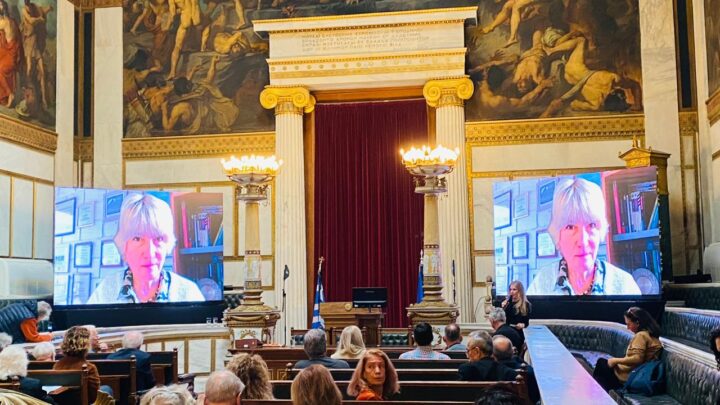
Introducing terrestrial microorganisms to such a destination could affect its environment and complicate the interpretation of future findings. Equally, returning samples to Earth requires safeguards for their transport and study. These two directions lie at the heart of the planetary protection principles Athena Coustenis discussed.
The COSPAR panel chaired by Athena Coustenis develops and updates the relevant international policy on the basis of scientific knowledge. Its work involves experts from different disciplines and representatives of space agencies, while companies developing space activities are also invited into the dialogue. Requirements are tailored to each mission’s destination and purpose, enabling exploration with the necessary safeguards.
The possibilities ahead are ambitious: landings on icy moons, subsurface investigations, exploration of Titan’s seas and sample return.
For Athena Coustenis, the interest in these worlds also has a personal origin. As she shared with the audience, an eyesight problem prevented her from pursuing her ambition to become an astronaut. Her journey continued through planetary science and participation in missions reaching the worlds she had wanted to explore.
Space Agencies: Inspiring and Impactful Missions
Nick Sergis: Greece’s Space Activities Are Expanding
Nick Sergis, Chief Executive Officer of the Hellenic Space Center (HSC), presented the connection between Greek scientific excellence and the country’s national space strategy. He has worked with the Magnetospheric Imaging Instrument (MIMI) team on Cassini–Huygens and collaborates with the Academy of Athens’ Center for Space Research and Technology.
His talk brought international exploration together with the infrastructure and services being developed in Greece. The Hellenic Space Center coordinates space activities and contributes to the development and implementation of the national strategy. Its operational role includes Earth observation services, using satellite data to address natural disasters and security needs.
A central topic was the National Microsatellite Programme. According to the figures Nick Sergis presented, it comprises 24 satellites developed in cooperation with ESA: seven optical, four thermal, two equipped with synthetic aperture radar and eleven experimental CubeSats. The programme also includes ground stations, assembly and testing facilities, and data-processing infrastructure.
The first phase represents €200 million for the 2023–2026 period. For the second phase, HELLAS-SPACE 2.0, Nick Sergis presented plans amounting to €350 million for 2026–2030, with a target of at least 50% Greek participation. The involvement of companies, universities and research organisations connects these investments with the development of expertise in Greece.
Greek scientific teams also contribute to missions including Cassini–Huygens, Rosetta, Mars Express, Juice, Europa Clipper, BepiColombo and Hera. Their research covers planetary surfaces and atmospheres, data analysis and environments that may offer conditions suitable for life.
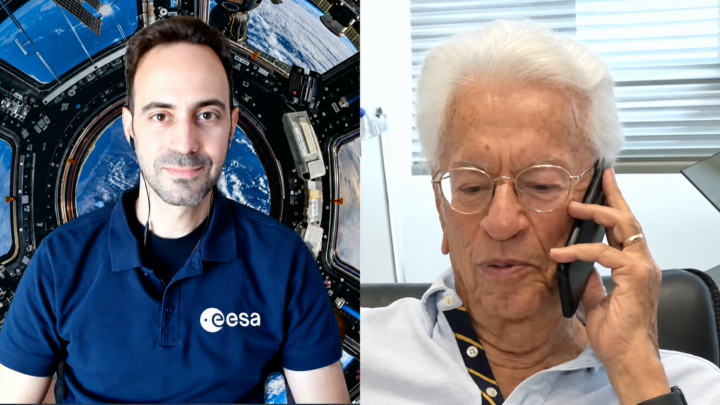
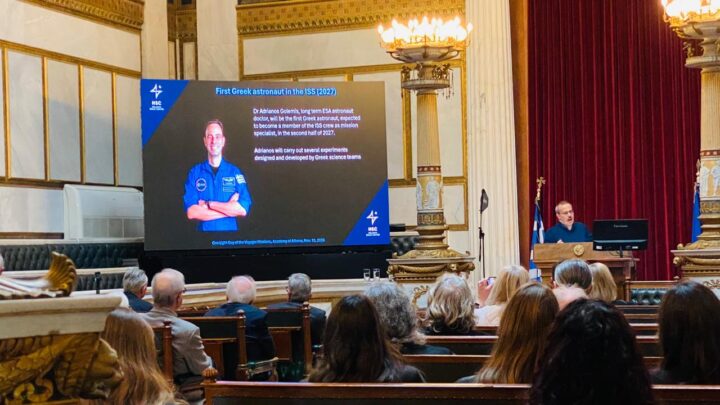
Another prospect is opening with the anticipated participation of astronaut Adrianos Golemis, a Komvos Partner, in a mission to the International Space Station in 2027. As Nick Sergis explained, the Greek physician is expected to carry out experiments designed by Greek research teams, extending domestic research into another field of international cooperation.
Stamatios Krimigis: From the Sun to the Galaxy
Stamatios Krimigis, a member and former President of the Academy of Athens and Emeritus Head of the Space Department at the Johns Hopkins University Applied Physics Laboratory, presented six decades of space exploration. A Komvos Partner and Principal Investigator of Voyager’s LECP experiment, he is the only person to have “travelled”, through his scientific instruments, from the Sun to every planet, out to distant Pluto and further still, into interstellar space.
“We never imagined it would last this long.”
Stamatios Krimigis, on Voyager’s longevity
Entitled “From the Sun to the Galaxy and Places in Between”, his talk connected the earliest efforts to measure the space environment with missions to planets, asteroids and regions beyond the heliosphere. It began in the era of Explorer 1, the first US satellite, and the discovery of Earth’s radiation belts by James Van Allen and his team.
Working with James Van Allen as a graduate student, Stamatios Krimigis built his first instrument for Mariner 4. The mission launched in 1964 and encountered Mars in July 1965. A historic photograph showed the Greek scientist with his mentor and Thomas Armstrong, beside another instrument from the same period. Within four years, their research had produced eight instruments for missions to Mars, Earth, the Moon and Venus.
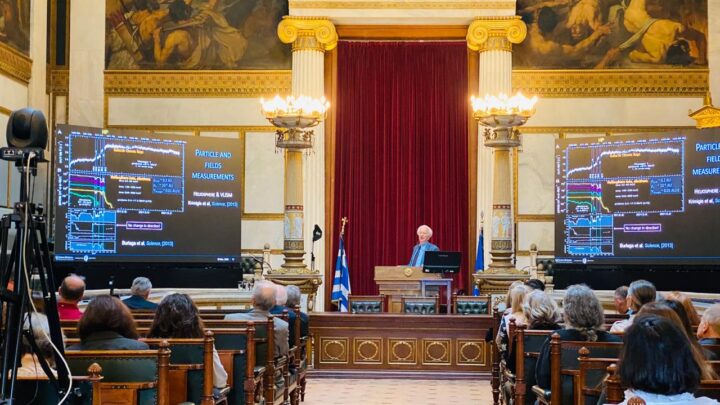
Voyager followed, with Stamatios Krimigis joining the original team as its youngest instrument Principal Investigator. The measurements he presented trace changes in particle populations as the spacecraft move away from the Sun. Voyager data are combined with other observations to build a broader picture of the heliosphere’s shape and its interaction with the galactic environment.
His account also covered AMPTE, a collaboration between the United States, the United Kingdom and Germany to study space plasma, and the NEAR mission to the asteroid Eros. For the latter, Stamatios Krimigis recalled an incident in the moments before landing.
As he recounted, NASA’s then Administrator, Daniel Goldin, made a last-minute request to stop the procedure, fearing that a failure would embarrass the agency. The descent command, however, had already been sent to the spacecraft and could no longer be recalled. The team awaited the outcome: on 12 February 2001, NEAR successfully touched down on Eros, achieving the first landing on an asteroid.
References to Cassini, DART and Parker Solar Probe extended the account to Saturn exploration, planetary defence and close approaches to the Sun. From the first instrument for Mars to measurements beyond the heliosphere, the talk followed an ongoing research effort, with new destinations and questions.
Nicola Fox: Every Additional Measurement Matters
Nicola Fox, Associate Administrator for NASA’s Science Mission Directorate, joined the symposium remotely to discuss Voyager’s legacy and the prospects for space exploration today. She previously served as Director of NASA’s Heliophysics Division and as Parker Solar Probe Project Scientist at the Johns Hopkins University Applied Physics Laboratory, researching the Sun and its influence on space.
For Voyager, continued exploration now depends on managing an ever-diminishing supply of power. Scientists and engineers must keep systems designed decades ago operating, carefully deciding how to use every remaining margin.
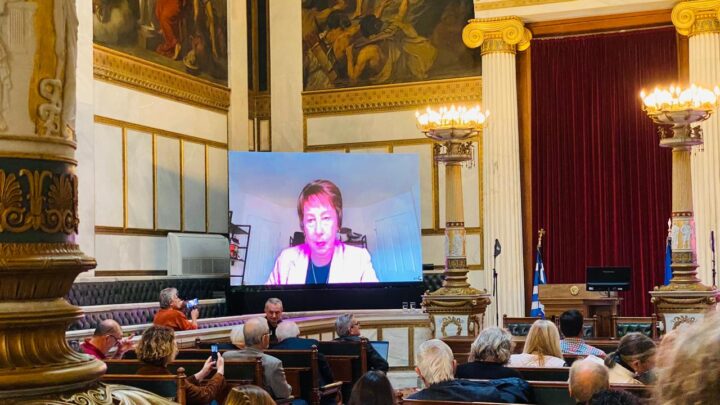
Nicola Fox highlighted the ingenuity of these teams and the technical interventions extending the spacecraft’s lives. Among other measures, she discussed “Big Bang”, a sequence of system changes intended to conserve power. At distances where a round-trip signal exchange takes nearly two days, every such action demands preparation, checks and patience.
The scientific value remains considerable. Voyager provides in situ measurements from regions that no new mission can reach in the near future. As Nicola Fox pointed out, even a new, faster spacecraft would need decades to approach interstellar space.
The prospect of a future mission, such as the Interstellar Probe concept, carries forward the questions Voyager opened up. Until then, teams on Earth continue to seek ways for both spacecraft to return new data. Every extension of their operation adds observations along a route that remains difficult to retrace.
Pioneers’ Reflections: Film Screening and Audience Discussion
Thomas Zurbuchen: The Pioneers Code
Thomas Zurbuchen, a professor at ETH Zurich and Director of ETH Zurich Space, brought experience of leading major scientific endeavours to the discussion. As NASA’s Associate Administrator for the Science Mission Directorate from 2016 to 2022, he oversaw missions including Perseverance, DART and the James Webb Space Telescope.
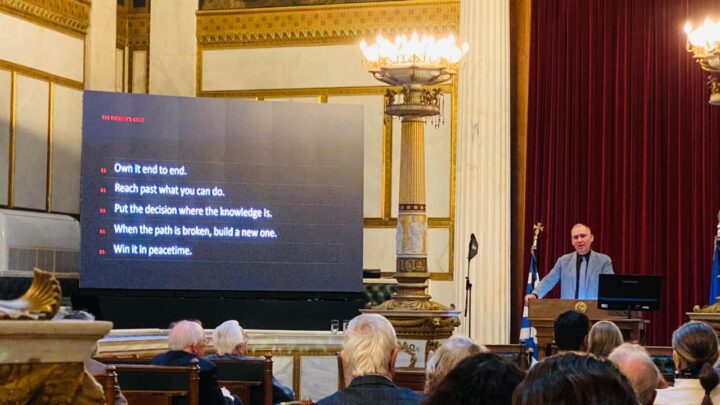
He introduced the approximately 30-minute film The Pioneers Code: Lessons Learned, in which he speaks with Stamatios Krimigis and Tom Young about their experience of designing and managing space missions. Their accounts illuminate questions running through Voyager’s history: how is a pioneering endeavour organised, who makes the decisions, and how are difficulties addressed when previous experience offers no ready answers?
Five principles capture this approach: taking responsibility from beginning to end; reaching beyond existing capabilities; placing decisions where the knowledge is; building a new path when the previous one is blocked; and preparing before the critical moment arrives.
Particular weight is given to keeping decisions close to the people with the relevant expertise. In a space mission, specialist knowledge is distributed across many teams. Ensuring that technical assessments and scientific observations are heard in time affects the course of the entire undertaking.
One striking formulation connects excellence with continuous improvement. Errors and failures need to be acknowledged, investigated and corrected, so that experience returns to the team as knowledge. Voyager’s history, with the successive adjustments that allowed the missions to continue, gives this principle concrete meaning.
A Meeting of Pioneers
The People Behind the Journey into the Unknown
In the closing discussion, Lennard Fisk, Thomas Zurbuchen, Ralph McNutt Jr. and Stamatios Krimigis joined Nadia Drake on stage. Questions created space for personal recollections, the conditions that enabled Voyager’s success, and the relationship between scientific research, uncertainty, collaboration and the public.
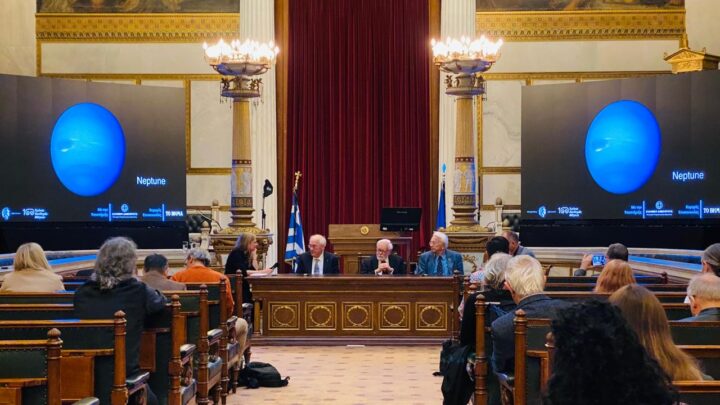
Thomas Zurbuchen focused on the people who grew alongside the mission. Scientists and engineers began with a particular timeframe and found themselves working together for decades, tackling new problems and redefining their objectives. The team’s continuity and common purpose became part of Voyager’s endurance.
Ralph McNutt Jr. spoke of the legacy of earlier generations of scientists and the determination of their students, many of whom were immigrants. Different backgrounds and experiences came together in teams seeking to achieve something never attempted before. The discussion also returned to the importance of scientists having the freedom to investigate, propose ideas and contribute to decisions.
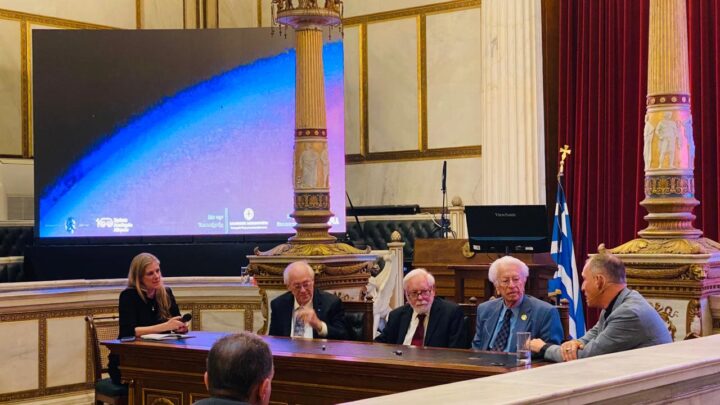
For Stamatios Krimigis, NASA’s decision to share images with the world as they arrived from the spacecraft was decisive. Television stations could broadcast the incoming feed, allowing the public to see new images almost at the same time as scientists. Daily press conferences accompanied the observations and explained their significance.
Viewers could follow exploration as it unfolded, sharing its surprises and questions. From one planetary encounter to the next, that relationship endured and reached new generations. The public grew up with the mission.
When Io Provided the Answer
Asked which scientific moment stood out from his years with Voyager, Stamatios Krimigis returned to the approach to Jupiter. His team’s instruments were detecting sulphur and oxygen, raising questions about their origin. The answer came when images revealed Io’s active volcanoes.
The Greek scientist recalled discussions with colleagues as they tried to interpret the measurements. The moon’s volcanic activity explains the presence of material feeding Jupiter’s magnetosphere. Particle detectors and images supplied different pieces of the same discovery.
Research Between Persistence and Reassessment
The account brought the discussion to the nature of research itself, with its repeated efforts, tests and revision of hypotheses. Ralph McNutt Jr. used a memorable phrase:
“If we knew what we were doing, it wouldn’t be called research.”
Nadia Drake, in turn, spoke of the need to change approach when an effort is unsuccessful, quoting the familiar saying:
“Insanity is doing the same thing over and over again and expecting different results.”
Between persistence and reassessment, the participants’ stories showed how an undertaking progresses without a ready-made map. An unusual measurement, a technical difficulty or an unexpected image can open the next path of inquiry.
A Legacy That Keeps Travelling
The symposium also highlighted the Greek space ecosystem: scientists, research teams and organisations participating in international exploration while building new capabilities at home.
Nearly fifty years after launch, Voyager continues to return data and raise questions. Available power is gradually declining, and teams on Earth are seeking ways to prolong operations. Eventually, the last scientific instruments will fall silent, while the two spacecraft continue on their way.
The knowledge they have provided will, in turn, continue to inform new research and missions. In Athens, the accounts of the people behind Voyager showed the long road from a scientific idea to discovery, and how many people contribute along the way. As long as Voyager’s signals still reach Earth, that story continues to be written.