The National Technical University of Athens honoured the member of the Academy of Athens and Partner of Komvos for his contribution to space science. An evening of historical reflection, emotion and lessons for Earth’s future.
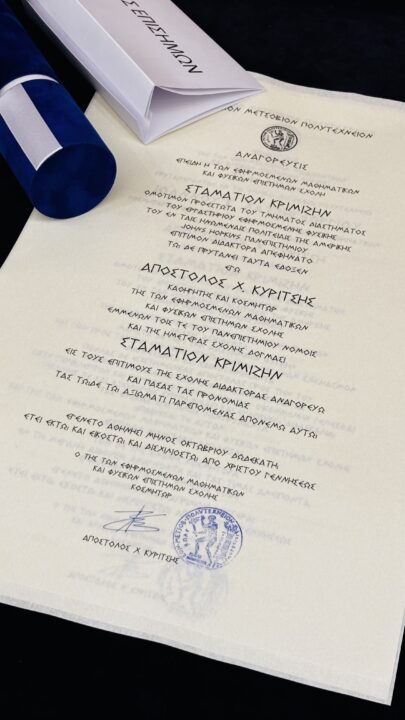
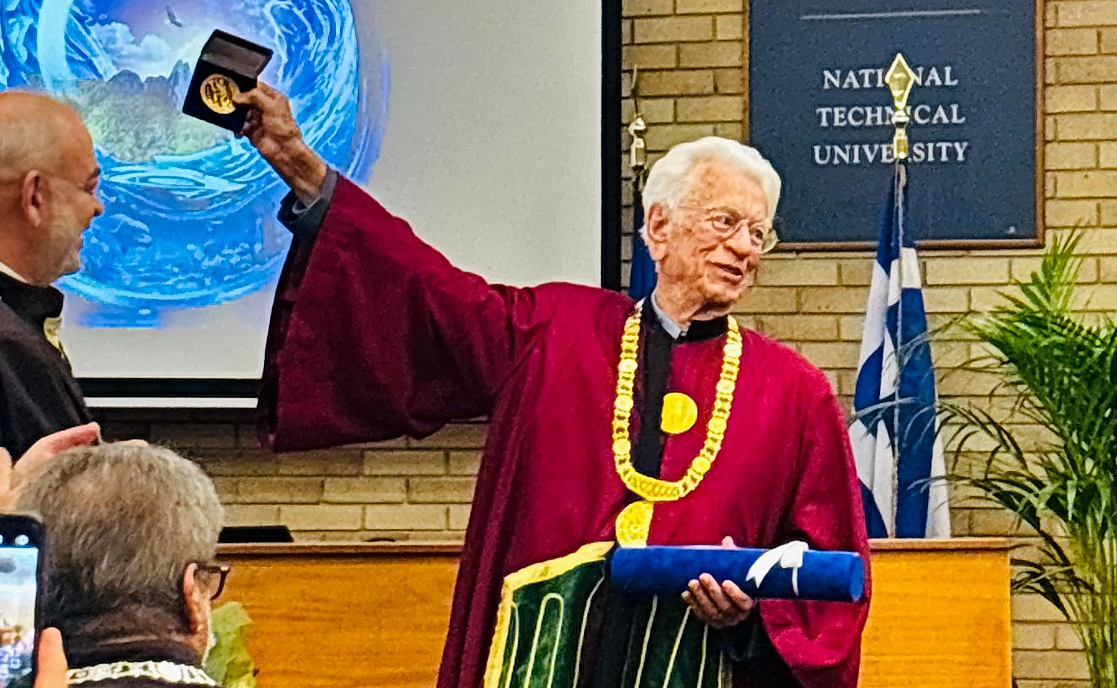
Dr Stamatios Krimigis received an honorary doctorate from the School of Applied Mathematical and Physical Sciences at the National Technical University of Athens on Monday, 12 October 2026. The ceremony at the Zografou campus brought together scientists, collaborators and friends who came to honour a career closely associated with the exploration of the Solar System.
There was a warm atmosphere from the moment he entered the hall. Guests approached him to greet him and exchange a few words, and he responded with warmth and ease. Later, speaking from the podium, he expressed his happiness and emotion at the honour bestowed on him by the University.
The ceremony opened with addresses by the Rector of NTUA, Professor Ioannis K. Hatjigeorgiou, and the Dean of the School, Professor Apostolos H. Kyritsis. Professor Alexandros Kehagias presented the honouree’s work. The conferment of the honorary doctorate was followed by Professor Krimigis’s address and the presentation of the NTUA Medal by the Rector.
Stamatios Krimigis’ journey through space missions
Alexandros Kehagias’ presentation gave the evening its historical depth. Through missions, discoveries and moments from Stamatios Krimigis’s life, it traced a career that began in the early years of the Space Age and extended to measurements beyond the heliosphere.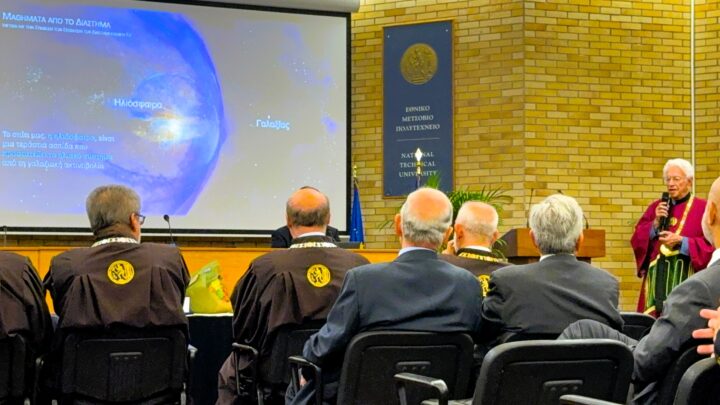
From Chios, Professor Krimigis moved to the United States, where he studied Physics at the University of Minnesota before continuing at the University of Iowa. There, he worked with James Van Allen, the scientist who discovered Earth’s radiation belts. In 1968, he joined the Johns Hopkins University Applied Physics Laboratory, where he later became Head of the Space Department.
One slide took the audience back to Iowa in 1963, when Van Allen invited the young researcher to join the first mission to Mars. That invitation led to his contribution to Mariner 4, which made the first successful flyby of the planet in 1965 and returned its first close-up images. The detector on which Stamatios Krimigis worked helped establish that Mars does not have radiation belts comparable to Earth’s. Mariner 5 followed, travelling to Venus in 1967.
Voyager 1 and 2, launched in 1977, stand out in this journey. As Principal Investigator for the Low Energy Charged Particle experiment, known as LECP, Krimigis contributed to the study of the environments of the giant outer planets. Both spacecraft subsequently crossed the heliopause, the boundary of the region dominated by the solar wind, enabling direct measurements in interstellar space. LECP data played a decisive role in establishing that Voyager 1 had left the heliosphere in 2012.
Another chapter was Cassini at Saturn, with the MIMI experiment and the imaging of the magnetosphere using energetic neutral atoms. The retrospective also covered missions such as NEAR to the asteroid Eros, MESSENGER to Mercury, New Horizons to Pluto and Parker Solar Probe towards the Sun. Together, they highlighted his contribution both to scientific instruments and to the development of space programmes.
A striking coincidence linked two milestones: on 14 July 1965, Mariner 4 made its close approach to Mars; exactly fifty years later, on 14 July 2015, New Horizons made its close approach to Pluto. Between those two dates lies much of the history of planetary exploration — and of Stamatios Krimigis’s scientific life.
Listening to the retrospective, one had the sense that the history of the Space Age was unfolding through Stamatios Krimigis’ life — a story that continues. He remains active in Voyager research, while the mission teams seek ways to extend the spacecraft’s operations almost half a century after launch. As the available electrical power declines, each intervention requires careful decisions about which systems will remain active and how to preserve the valuable measurements from interstellar space.
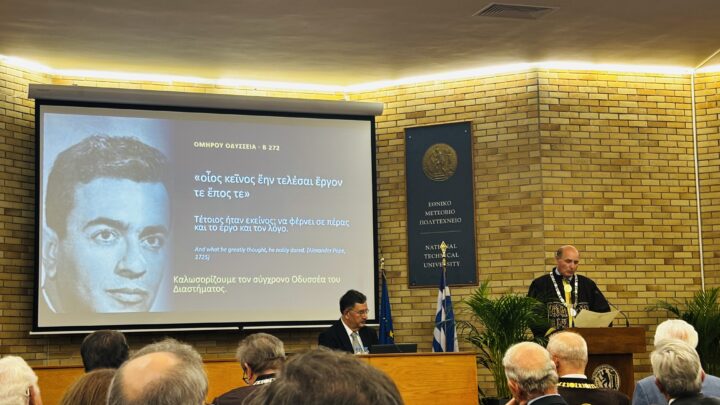
Professor Alexandros Kehagias concluded his presentation with a verse from the Odyssey, welcoming the honouree as a modern Odysseus of space.
What does space teach us about Earth?
In his address, entitled “Lessons from Space on the Survival of the Passengers of Spaceship Earth”, Stamatios Krimigis connected the exploration of other planets with the conditions that make life possible on our own. The experience of space missions became the starting point for a discussion about protecting Earth and the responsibilities of its inhabitants.
The comparison between Earth and Mars highlighted the importance of our magnetic environment. A magnetosphere is the region in which a planet’s magnetic field dominates and influences the movement of charged particles. On Earth, it plays an important role in protection from the solar wind; Mars has a very different magnetic environment.
Venus provided the second example: a dense carbon dioxide atmosphere and surface temperatures of approximately 462 degrees Celsius. Professor Krimigis described the powerful greenhouse effect on our neighbouring planet before turning to rising carbon dioxide levels in Earth’s atmosphere, connecting planetary research with our understanding of climate change.
From Saturn’s rings and moons to the heliosphere, the narrative gradually widened in scale. The heliosphere, the vast region created by the solar wind around the Solar System, reduces its exposure to galactic cosmic radiation. The Voyager spacecraft have made it possible to study its boundaries and the environment beyond them.
The distances involved also prompted a humorous exchange. Professor Krimigis observed that even NTUA’s outstanding scientists had not yet managed to build satellites capable of travelling at the speed of light. The reply was that, now that he too belonged to the University, perhaps they would succeed!
The address concluded with the observation that humanity had opened two “Pandora’s boxes” simultaneously: artificial intelligence and climate change. The survival of the human species, Stamatios Krimigis emphasised, depends on how well we manage both.
At 88, research remains part of his daily life
The honorary doctorate found Stamatios Krimigis still active in the science he has served for decades. As he noted, at 88 he continues to work 60 hours a week, adding with humour that his wife does not approve of this pace. In the coming days, he is due to travel to the United States again.
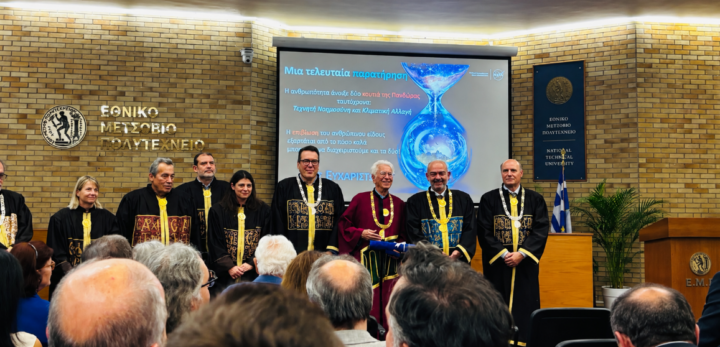
Many friends, colleagues and people close to Stamatios Krimigis gathered in the hall to share the joy of his honorary doctorate. They included Komvos Partners Adrianos Golemis, Doros Theodorou, George Nounesis and Ares Rosakis. Also attending were Emmanuel Rammos, President of the Hellenic Space Center, and Ioannis Daglis, Professor of Space Physics at the National and Kapodistrian University of Athens. Journalist Makis Provatas, who collaborated with Professor Krimigis on his book Όλα σε μια ζωή — Από τον Ήλιο στον Γαλαξία (Everything in One Life — From the Sun to the Galaxy), was also present.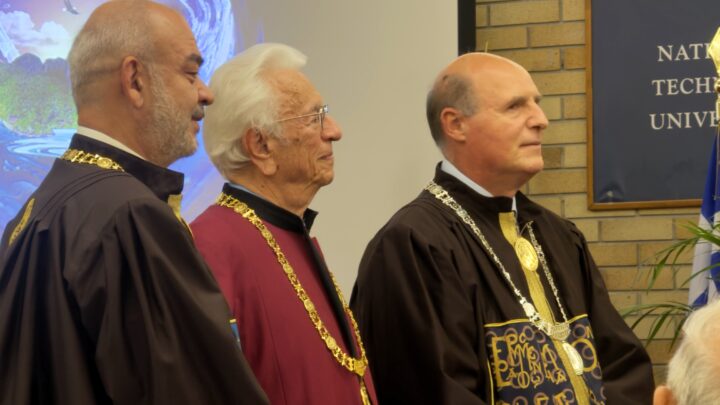
For Komvos, the honour bestowed on its Founding Member and Partner also reflects his contribution as a lead of the “Space Science, Technology and Industry” initiative. The NTUA ceremony captured this continuity: a scientific career of historical significance, a researcher who continues to work, and his personal emotion at the recognition of his achievements.