You are currently viewing Christina Koulouri at Women in Business & Science

Christina Koulouri at Women in Business & Science

When history becomes a way of understanding the present

Some interviews simply present a personal journey. Others, through that journey, open up a wider conversation: about knowledge, society, leadership, education, and the way we make sense of the world around us.

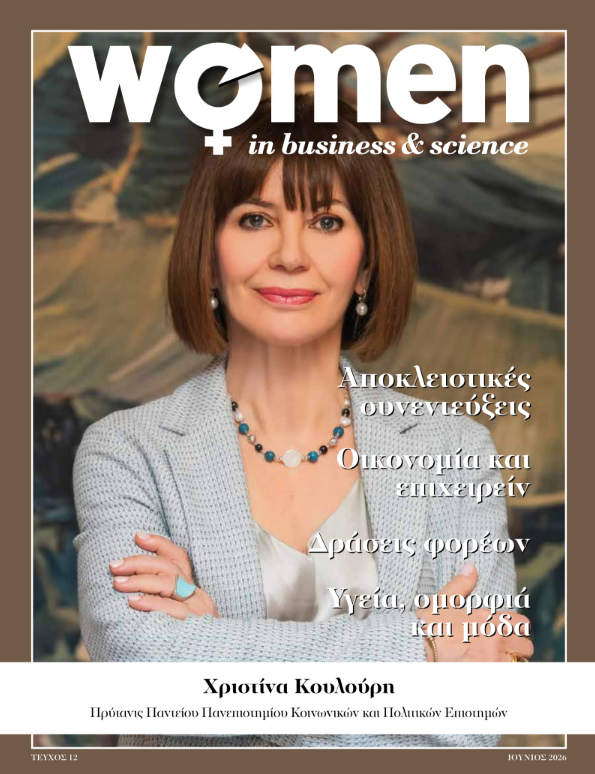
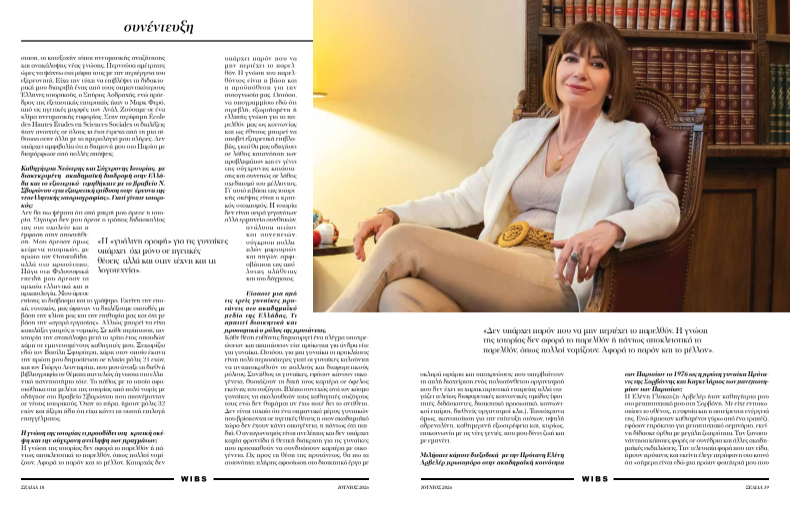
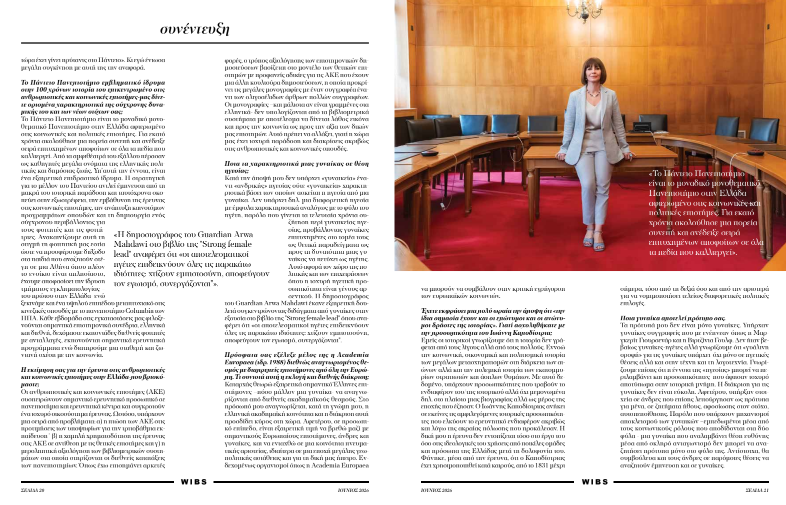
The central interview of Prof. Christina Koulouri in Women in Business & Science, titled “Knowledge of the past is the basis and prerequisite for our self-awareness,” belongs to the second category.

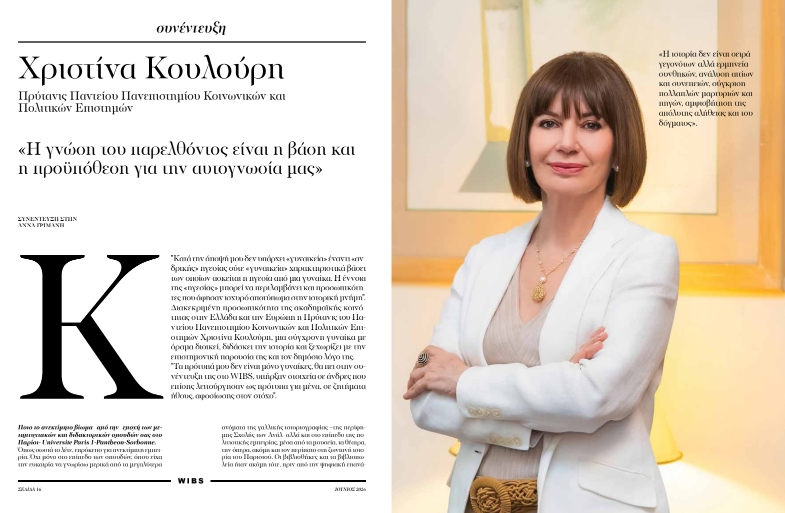
εικονα απο το περιοδικο 1

Christina Koulouri, Rector of Panteion University of Social and Political Sciences, Professor of Modern and Contemporary History, Partner of Komvos and member of the Advisory Committee of the Ai’nclusion initiative on Artificial Intelligence, speaks with Anna Grimani about her journey, history, the social sciences, the position of women in leadership roles, and the importance of critical thinking.

The interview is conducted by journalist Anna Grimani, member of the Board of Directors and also Partner of Komvos. Her journalistic perspective gives the conversation rhythm and human depth: it sheds light not only on the institutional role of the Rector, but also on the journey of a woman who reached knowledge through libraries, teachers, questions, perseverance, and a constant search for understanding.

A magazine for women who produce knowledge and value

Women in Business & Science creates a space for public discourse around women who produce knowledge, create value, and make a meaningful contribution to science, entrepreneurship, culture, and society. It does not confine itself to a simple presentation of individuals.

For this reason, the choice of Christina Koulouri as the subject of the central interview carries particular significance. The historian and Rector of Panteion University is presented within a context that highlights women with work, voice, and public presence — not as exceptions, but as part of a broader reality that needs to become more visible.

History beyond memorisation

One of the most interesting points in the interview is the distance Christina Koulouri takes from the narrow, school-based understanding of history. History, as reflected in her thinking, is not a list of events, nor a field of memorisation. It is a way of interpretation.

She recalls that, at school, the way history was taught did not win her over. What won her over later were the texts, the professors, the international bibliography, the experience of Paris, the encounter with French historiography, and the sense that the past does not lie behind us like a closed archive. It lives within the present.

“Knowledge of the past is the basis and prerequisite for our self-awareness”

This is also the essence of the phrase that gives the interview its title: knowledge of the past is the basis of self-awareness. A society that knows its history in a distorted, superficial, or idealised way risks misunderstanding its present. And when it misunderstands the present, it designs the future incorrectly.

From Paris to Panteion

Christina Koulouri’s path passes through Paris and the Sorbonne, through libraries and open lectures, through the Annales School and through teachers who decisively shaped the way she approached historical scholarship.

In the interview, she describes that period not only as an academic experience, but also as an intellectual awakening. Museums, theatres, libraries, conversations, and Paris itself become part of a formation that went far beyond the limits of formal study.

From that experience to her current position as Rector of Panteion University, one consistent thread can be discerned: the belief that the social sciences and the humanities have an essential role to play in understanding our time.

Panteion University and the value of the social sciences

Panteion University is presented in the interview in its true dimension: as an institution with a distinct identity, being the only single-theme university in Greece dedicated to the social and political sciences.

Christina Koulouri refers to its dynamism, its outward-looking orientation, its research activity, its new study programmes, and its steady relationship with society. This reference points to a broader question: what is the place of the social sciences in an era that often measures progress only through technological or economic indicators?

“There is no present that does not contain the past”

The answer running through the interview is clear. The social sciences give depth to our understanding of change. They explain institutions, behaviours, inequalities, historical continuities, and social ruptures. They help us see that behind every technological or political development there are people, societies, and values.

The connection with Artificial Intelligence and the Ai’nclusion initiative

Christina Koulouri’s participation in the Advisory Committee of Komvos’ Ai’nclusion initiative is particularly significant precisely because it brings this perspective into the discussion on Artificial Intelligence.

The debate on AI cannot be limited to tools, algorithms, or applications. It concerns education, equality, language, access to knowledge, democracy, the citizen’s relationship with information, and ultimately, critical technological literacy.

In this field, historical awareness and social understanding are necessary preconditions. Technology changes rapidly. Societies, however, need time, education, and critical thinking in order to integrate it in a way that is fair, inclusive, and human-centred.
Λογότυπος MIT Day of AI Teacher Training του Κόμβου για την τεχνητή νοημοσύνη στην εκπαίδευση

This is exactly what Ai’nclusion seeks to highlight: that Artificial Intelligence should be discussed not only as a technological possibility, but also as a social issue.
Leadership without stereotypes

The interview also touches on the issue of women’s leadership, but in a way that avoids easy distinctions. Christina Koulouri points out that there is no “female” and “male” leadership in simplistic terms. There is leadership that builds trust, avoids ego, collaborates, and assumes responsibility.

This position is valuable because it shifts the discussion from identity to the quality of leadership. From gender to the way responsibility is exercised. From image to substance.

Her recent election to Academia Europaea adds to this trajectory as a form of international academic recognition. It is a personal distinction, but also an indication of the presence of the Greek scientific community within the European space of knowledge.

A meeting of particular significance for Komvos

Christina Koulouri’s interview in Women in Business & Science carries particular significance for Komvos, as it brings together three elements that lie at the heart of its mission.

The scientific excellence and public presence of Christina Koulouri. The journalistic contribution of Anna Grimani, who highlights people and ideas with social and scientific impact. And the editorial identity of a magazine that gives space to women who meaningfully influence the fields in which they are active.

Above all, however, the interview reminds us of something directly relevant to our time: in order to speak seriously about the future, we need to understand the past. And in order to use technology responsibly, we need to keep critical thinking, historical awareness, and social responsibility alive.

This is where history, journalism, education, and Artificial Intelligence meet. And this is where the dialogue opened by the interview acquires meaning beyond the pages of a magazine.

You can read the full interview here (in Greek).