A New International Distinction for a Komvos Partner
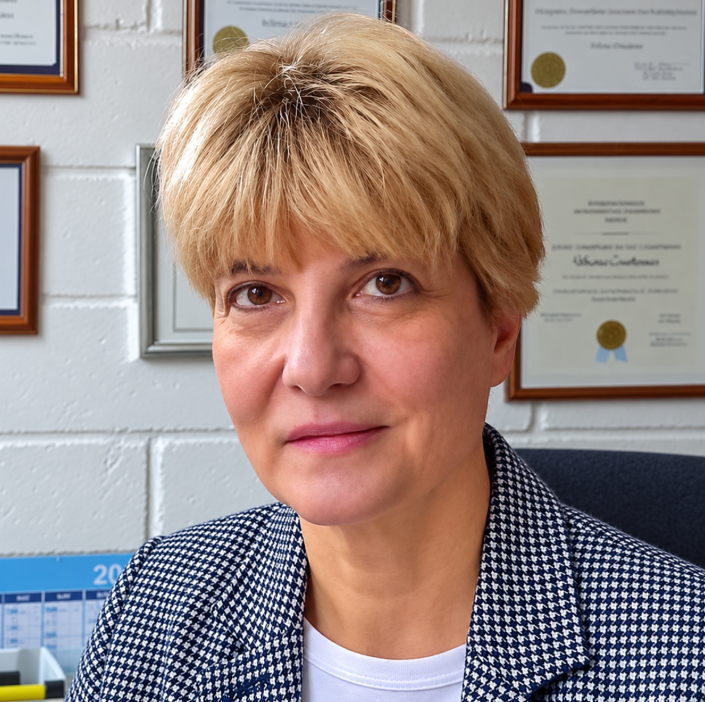
Athena Coustenis, astrophysicist and planetary scientist, Director of Research at CNRS at the Paris Observatory, member of the Governing Board of the Hellenic Space Center and Partner of Komvos, has been selected to receive the Charles A. Whitten Medal 2026 of the American Geophysical Union (AGU).
The distinction was announced on 24 September 2026 and is awarded every two years to scientists who have made significant contributions to the study of the Earth and planets. The medal will be presented at the AGU Annual Meeting in San Francisco, from 7 to 11 December 2026.
From Titan to Today’s Space Missions
Athena Coustenis’ scientific career is closely linked to the exploration of the Solar System, particularly the study of planetary atmospheres and surfaces.
For more than three decades, she has studied Titan, Saturn’s largest moon. She participated as a Co-Investigator on scientific instruments aboard the Cassini–Huygens mission, contributing to the analysis of data on its atmosphere and surface.
Her connection with Titan began even earlier. In 1998, an international research team in which she participated presented evidence for the presence of water vapour in the moon’s atmosphere, based on observations from ESA’s Infrared Space Observatory.
Today, she serves as a Co-Investigator on ESA’s JUICE and ARIEL missions and JAXA’s MMX mission, spanning research from the exploration of Jupiter’s icy moons to the study of exoplanets and the moons of Mars.
What is Athena Coustenis studying today?
Her research focuses on the atmospheres and surfaces of planets and moons, their origins and evolution, and the conditions for habitability within the Solar System and on exoplanets.
Particular emphasis is placed on the icy moons of the outer planets, including Titan, Enceladus, Ganymede and Europa, which are among the key targets of contemporary planetary research.
In May 2026, an international study on Ganymede was presented, with the participation of Athena Coustenis and planetary geologist Anezina Solomonidou, a member of Komvos’ International Advisory Committee. The study identified areas of the moon with potential cryovolcanic interest that could become observation targets for ESA’s JUICE mission.
A Second Major Distinction in 2026
The Charles A. Whitten Medal is Athena Coustenis’ second major international distinction in 2026.
In June, she was elected to Academia Europaea, in the Earth & Cosmic Sciences section, with Astrophysics and Planetology as her research fields. Her election recognised her contribution to planetary sciences and international scientific collaboration.
She has also received major international scientific distinctions in the past and has been awarded the rank of Knight of the Légion d’honneur in France.
Athena Coustenis and Greece’s Space Ecosystem
Alongside her international research activity, Athena Coustenis also plays an active role in Greece’s space ecosystem.
She is a member of the Governing Board of the Hellenic Space Center and maintains an active role in connecting the Greek scientific community with international missions, research networks and organisations.
Her professional base remains in Paris, where she holds the position of Director of Research, Exceptional Class, at CNRS, at LIRA of the Observatoire de Paris–PSL.
Her Connection with Komvos
Dr Athena Coustenis is a Founding Member and Partner of Komvos and has been involved from the early stages in shaping the organisation’s activities in space science and industry.
Together with Academician Stamatios Krimigis, also a Partner of Komvos, she is a coordinator of Komvos’ Space Science, Technology and Industry initiative. At the same time, together with Komvos Secretary General Konstantinos Drosatos, she coordinates the “Node of Ideas – Greece 2025–2040” initiative.
Her new distinction from the American Geophysical Union adds another milestone to a scientific career extending from Cassini–Huygens and Titan to JUICE, the study of icy moons and exoplanets.
For Komvos, her presence reflects precisely this connection: Greek scientific expertise, international missions and participation in a space ecosystem of growing importance for the country.