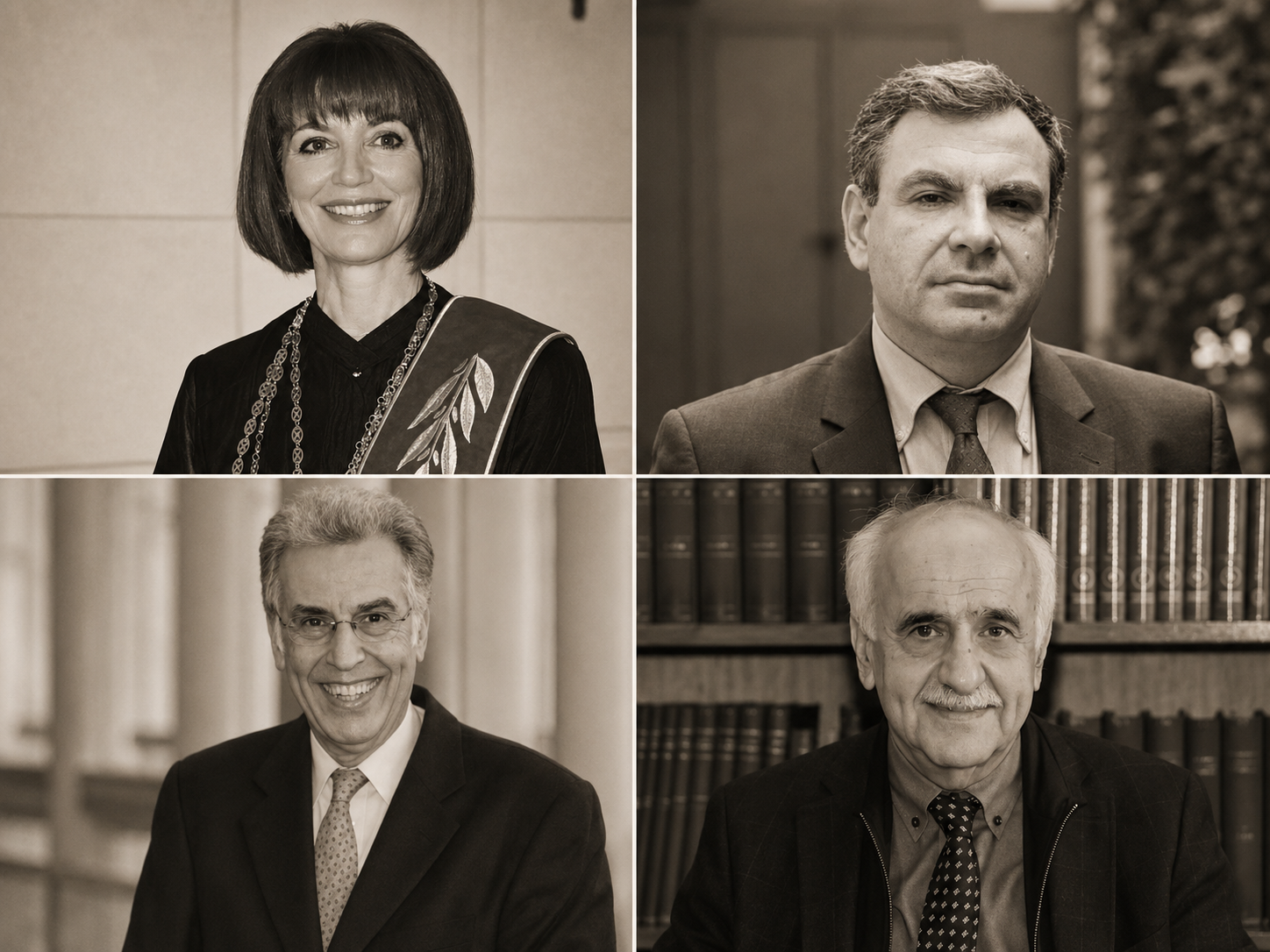
Four Komvos partners featured in Naftemporiki’s collector’s edition
Naftemporiki has released its collector’s edition, “In the Minds of Greek Intellectuals”, bringing together 52 essays by 54 leading figures from academia and science, the economy, politics, culture, and the arts. Adopting a broad understanding of what it means to be an intellectual, the publication seeks to bring critical thinking into the public conversation and shed light on aspects of Greece’s social and economic reality that often remain beyond a narrow reading of events and statistics.
The contributions span an equally broad range of topics, including democracy and institutions, war and peace, artificial intelligence, education, healthcare, the environment, the economy, historical memory, and the role of culture in the contemporary world. Contributors include, among others, His All-Holiness Ecumenical Patriarch Bartholomew, Archbishop Ieronymos II of Athens and All Greece, Lina Mendoni, Evangelos Venizelos, Yannis Stournaras, Theodosios Tassios, Titos Patrikios, George Babiniotis, Demetrios Nanopoulos, Christos Zerefos, Athanassios Fokas, Michalis Bletsas, Anastasia Kotanidou, Maria Efthymiou, Thanos Veremis, Alkistis Protopsalti, Mariza Koch, and Lambros Liavas.
Among the contributors are four active partners of Komvos: Christina Koulouri, Nikiforos Diamandouros, Michalis Tiverios, and Nikos Vettas. Although their essays emerge from different academic disciplines, they converge on fundamental questions that concern every society: how it engages with its past, how it safeguards its institutions, how it transforms the traces of history into knowledge, and how it harnesses its strengths to build a sustainable future.
Christina Koulouri: Education Between War and Reconciliation
Christina Koulouri, Professor of Modern and Contemporary History and Rector of Panteion University, writes about an issue that persistently returns throughout human history: war and violence. In her essay, “War and Peace,” she shifts the focus from the astonishing pace of emerging technologies to a much older and far more enduring human phenomenon.
As she notes, the constant reproduction of images of war and violence may gradually lead to their normalization. Yet behind every conflict lies a traumatic past that can either perpetuate new cycles of hatred or become the starting point for reconciliation. This is where education assumes a decisive role: schools can reproduce the image of the eternal enemy, but they can also provide the conditions necessary for confronting and processing collective trauma.
Christina Koulouri’s scholarly trajectory is closely connected to these questions. She studied History and Archaeology at the National and Kapodistrian University of Athens and continued her studies at the École des Hautes Études en Sciences Sociales (EHESS) and Paris 1 Panthéon-Sorbonne University, where she earned her doctorate. For seventeen years, she chaired the History Education Committee of the Center for Democracy and Reconciliation in Southeast Europe (CDRSEE) and coordinated the Joint History Project, an initiative that brought together educators and historians from different countries to engage with the multiple interpretations of an often contested past.
Nikiforos Diamandouros: Institutions and the Hard-Won Achievement of Trust
Nikiforos Diamandouros, President of the Academy of Athens, examines the role of institutions at a time when successive crises are testing both the effectiveness of governance and citizens’ trust.
In his essay, “The Academy of Athens: A Century of History, a New Era of Challenges,” he argues that trust is never a permanent achievement. It is built through consistency, transparency, participation, and continuous accountability. Armed conflicts, the climate crisis, rapid technological advances, and geopolitical upheavals cannot be addressed effectively by isolated state structures; they require cooperation, democratic legitimacy, and institutions capable of looking beyond the constraints of the moment.
Within this context, he reflects on the Academy of Athens as it enters the second century of its history. Openness, knowledge, and research are presented as the foundations of a more active public role, with the Academy called upon to contribute to social cohesion and to the development of a stable vision for the future.
Nikiforos Diamandouros is Professor Emeritus of Comparative Politics at the National and Kapodistrian University of Athens (NKUA) and a Full Member of the Academy of Athens. He served as Greece’s first Ombudsman from 1998 to 2003 and as the European Ombudsman from 2003 to 2013. His scholarly work focuses, among other areas, on democratization, state-building, good governance, and the relationship between politics and culture—fields that underscore the significance of his contribution on the quality and resilience of democratic institutions.
Michalis Tiverios: Archaeology as the Science of Human Memory
Michalis Tiverios, Member of the Academy of Athens and Professor Emeritus at the Aristotle University of Thessaloniki, reflects on “Archaeology in the 21st Century,” beginning with a broader observation: the declining prominence of the humanities in societies that increasingly evaluate knowledge primarily in terms of its immediate economic value.
In his view, archaeology has demonstrated remarkable resilience because it responds to the deeply human need to seek out our origins. Yet its purpose extends far beyond the discovery of material remains from the past. Its true scientific value lies in the systematic study, documentation, and publication of archaeological finds. For this reason, he emphasizes the importance of comprehensive excavation records and warns that an excavation whose results remain unpublished can ultimately prove damaging both to scholarship and to the archaeological evidence itself.
Michalis Tiverios studied at the Aristotle University of Thessaloniki and pursued postgraduate research at the Bonn Institute of Archaeology as an Alexander von Humboldt Foundation Fellow. He taught at the Aristotle University of Thessaloniki for nearly four decades and directed major archaeological excavations at the ancient settlements of Sindos and Karabournaki, near Thessaloniki. In 2011, he was elected a Full Member of the Academy of Athens, occupying the Chair of Archaeology, with a specialization in Ancient Greek Pottery.
Nikos Vettas: The Greek Economy Between Stability and Untapped Potential
In the field of economics, Nikos Vettas, Professor of Economics at the Athens University of Economics and Business (AUEB) and Director General of the Foundation for Economic and Industrial Research (IOBE), examines why Greece, despite the progress and stability it has achieved in recent years, continues to perform below its true potential.
The title of his essay, “High Potential on a Low Trajectory,” captures his central argument. Institutional and macroeconomic stability have brought significant benefits, yet they have not translated into strong and sustainable growth momentum. Economic expansion continues to rely more on increases in the traditional factors of production than on productivity gains, innovation, and the adoption of new technologies.
At the same time, economic inwardness, the country’s relatively small productive scale, and its limited ability to attract talent and capital keep Greece in an intermediate position. Stability provides an essential foundation, but it must be coupled with greater openness, economies of scale, innovation, and higher value-added production if the country’s potential is to be transformed into genuine economic convergence and long-term prosperity.
Nikos Vettas has served as Director General of the Foundation for Economic and Industrial Research (IOBE) since 2013 and is Professor of Economics at the Athens University of Economics and Business. He holds a PhD in Economics from the University of Pennsylvania, has taught at Duke University and INSEAD, and has served on Greek and European competition policy bodies. His academic and institutional expertise in industrial organization, economic policy, and competition economics enables him to connect the broader macroeconomic picture with the mechanisms that shape productivity at both the firm and the national economy levels.
Four Different Starting Points, One Shared Aspiration
Although the four essays emerge from distinct fields of knowledge, together they form a coherent narrative. Education is called upon to prevent memory from turning into renewed hatred. Institutions must earn citizens’ trust every day. Archaeology must transform discovery into rigorously documented knowledge. The economy must move beyond stability toward productive renewal.
At a time when public debate is often driven by the pace of the news cycle, Naftemporiki‘s collector’s edition creates space for slower, more thoughtful reflection. The contributions of Komvos’ four partners serve as a reminder that progress is multidimensional: it requires historical awareness, trustworthy institutions, scientific rigor, and an economy capable of transforming its potential into innovation, sustainable growth, and shared prosperity.